
Keywords, Audiences and Remarketing: Three Different Targeting Questions
October 18, 2026
One Topic, Several URLs: Canonicals, Redirects and Language Versions
October 18, 2026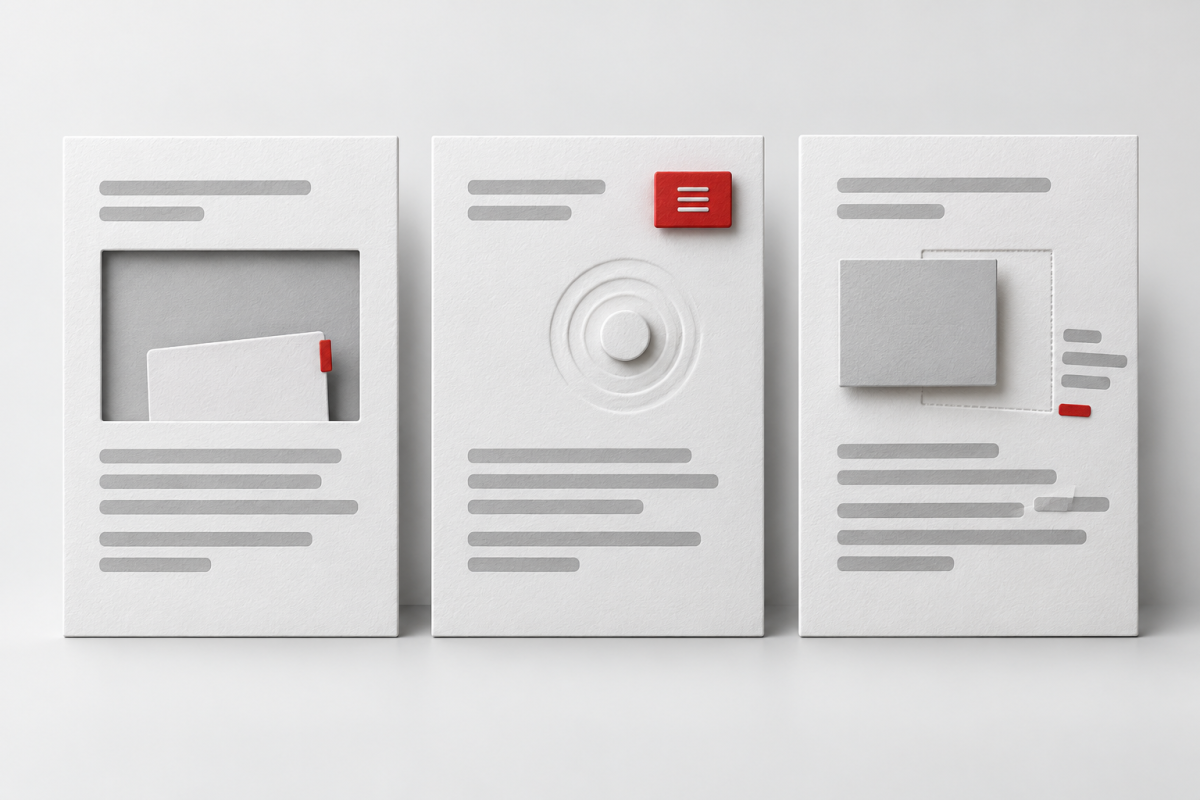
AI-generated conceptual illustration; no real page or performance measurement is shown.
A page can show its main content promptly and still hesitate when someone opens its menu. It can also respond quickly while a late-arriving panel pushes the text away. Calling all three experiences “slow” makes the problem harder to describe. Start by identifying what the visitor was waiting for, trying to do or trying to keep in view.
Core Web Vitals separate loading performance, responsiveness and visual stability. Google Search Central’s Core Web Vitals overview places these metrics in the context of real-world page experience. They offer focused evidence about those dimensions; they do not establish that the content is accurate, the page is accessible or a business outcome improved.
LCP asks when the largest visible content appears
Largest Contentful Paint, or LCP, reports when the largest eligible image, text block or video in the viewport is rendered, relative to navigation. The element depends on what is visible, so it need not be a site’s chosen cover image. The LCP reference explains why this differs from merely noticing the first pixels or waiting for every page resource.
Imagine a fictional guide with a large opening illustration, a menu and an optional information panel. One visitor sees the illustration appear late. That symptom motivates a loading question: which eligible element became LCP, and what delayed it? The description does not yet identify a cause or demonstrate that reducing the illustration’s file size would solve it.
INP asks how quickly an interaction reaches the next paint
Interaction to Next Paint, or INP, summarizes a visit’s click, tap and key-press responsiveness using a near-worst interaction with outlier handling. It includes input delay, processing and presentation until the next paint, rather than every eventual asynchronous result. The INP reference explains that visits without qualifying interactions may have no value; missing is not zero.
For the fictional guide, suppose tapping the menu produces delayed feedback after the illustration is visible. Which interaction was delayed, and what happened before its next paint? The late illustration and the delayed menu need separate investigations.
CLS asks whether content shifts unexpectedly
Cumulative Layout Shift, or CLS, is a unitless score for the largest burst of qualifying unexpected layout shifts across the page lifecycle. It is neither a duration nor the old lifetime sum. The CLS reference explains session windows and exclusions, including qualifying shifts shortly after user input. An initial screenshot cannot establish later stability.
In the fictional guide, a panel arrives while the visitor is reading and moves existing text unexpectedly. Follow the displaced content and what changed its position. The panel is a lead to investigate; its role has not been verified.
Read thresholds together with their population
| Signal | Experience represented | Good reference at field p75 |
|---|---|---|
| LCP | Loading | 2.5 seconds or less |
| INP | Responsiveness | 200 milliseconds or less |
| CLS | Visual stability | 0.1 or less, unitless |
The metric references apply these good thresholds to the 75th percentile of eligible field observations, separated into mobile and desktop populations.
A percentile describes a position in a distribution, rather than the arithmetic mean or one favorable visit. Keep the reported population and eligible observations visible alongside the value; a desktop result does not stand in for mobile.
Suppose an invented report for one stated mobile population and reporting window lists p75 LCP of 2.2 seconds, INP of 280 milliseconds and CLS of 0.06. Against the table, loading and stability meet their good references, while responsiveness is outside its good reference. These are stipulated teaching values, not calculated measurements from a real site, and they provide no cause for the slower interaction.
Lab and field describe different evidence
A lab result comes from controlled conditions; field data comes from observed real visits with varied devices, networks and behavior. The web.dev explanation of lab and field differences describes why their numbers can disagree. A repeatable test helps investigate a scenario, while a field distribution shows the represented visitors’ experiences. Neither should silently replace the other.
A load-only lab run can miss later interactions and shifts. INP needs relevant interactions, and CLS can include post-load movement. State what was observed before generalizing beyond it.
Make comparisons answer the same question
Before comparing results, record the URL or grouping, device population, reporting window, tool and metric definition. Retain a controlled test’s device, network, cache and interaction conditions, and a field dataset’s actual scope and coverage. Explain mismatched populations or periods rather than presenting them as a clean before-and-after improvement.
For the fictional guide, a useful review note would contain three separate observations: delayed opening illustration, delayed menu feedback and displaced reading text. Each needs its own evidence and proposed check. Changing several things at once would make it harder to determine which change explains an observed difference. The purpose of the note is to narrow the next question, not to declare a score fixed.
The same habit of tracing a symptom back to the first unsupported step appears in Agent Observability: Traces Metrics and Finding the First Wrong Step. For the separate question of how search engines discover and index pages, continue with Found, Crawled, Indexed: Why These Are Different States. A performance classification does not answer those discovery questions or establish a search-position gain.
Read the three signals as a map of questions: when important content became visible, how an interaction reached visual feedback and whether the layout moved unexpectedly. Then connect each question to evidence from the relevant visitors and conditions. A stronger explanation names what the measurement supports, what remains unknown and which focused investigation could resolve it.