
ABOUT
About Me and the Site
Strategic Integrator · Google AI Professional · Digital and AI Practitioner
I connect applied AI, automation, digital marketing, web systems and evidence-first research to build practical systems for real work.
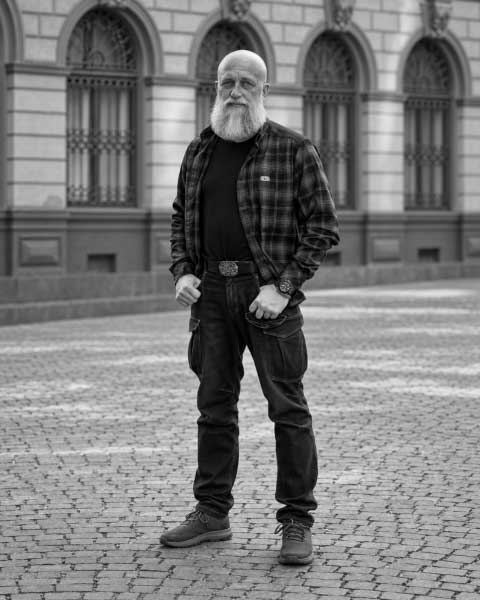
I am a Strategic Integrator, Google AI Professional and multidisciplinary digital practitioner. I work where applied AI, automation, digital marketing, web systems, research and project management meet.
My focus is not technology for its own sake. I am interested in how tools become dependable working systems: how information is verified, how responsibilities are defined, how processes can be repeated, and how people remain in control when automation becomes more capable.
CURRENT WORK
What I work on now
My current work brings together AI assistants, personal AI systems, workflow automation, content systems, research, digital marketing and the development of web projects. I use AI for practical tasks such as planning, analysis, content production and process support, while treating sources, permissions, privacy and review as part of the system rather than as an afterthought.
I have completed the Google AI Professional Certificate, created more than 20 AI artifacts, and developed my own system for digital representations of a person and human character with related automation. That portfolio continues to grow. The private architecture, data and operating details remain private; what I share publicly is the reasoning, method and evidence that can help other people build safer and more useful systems.
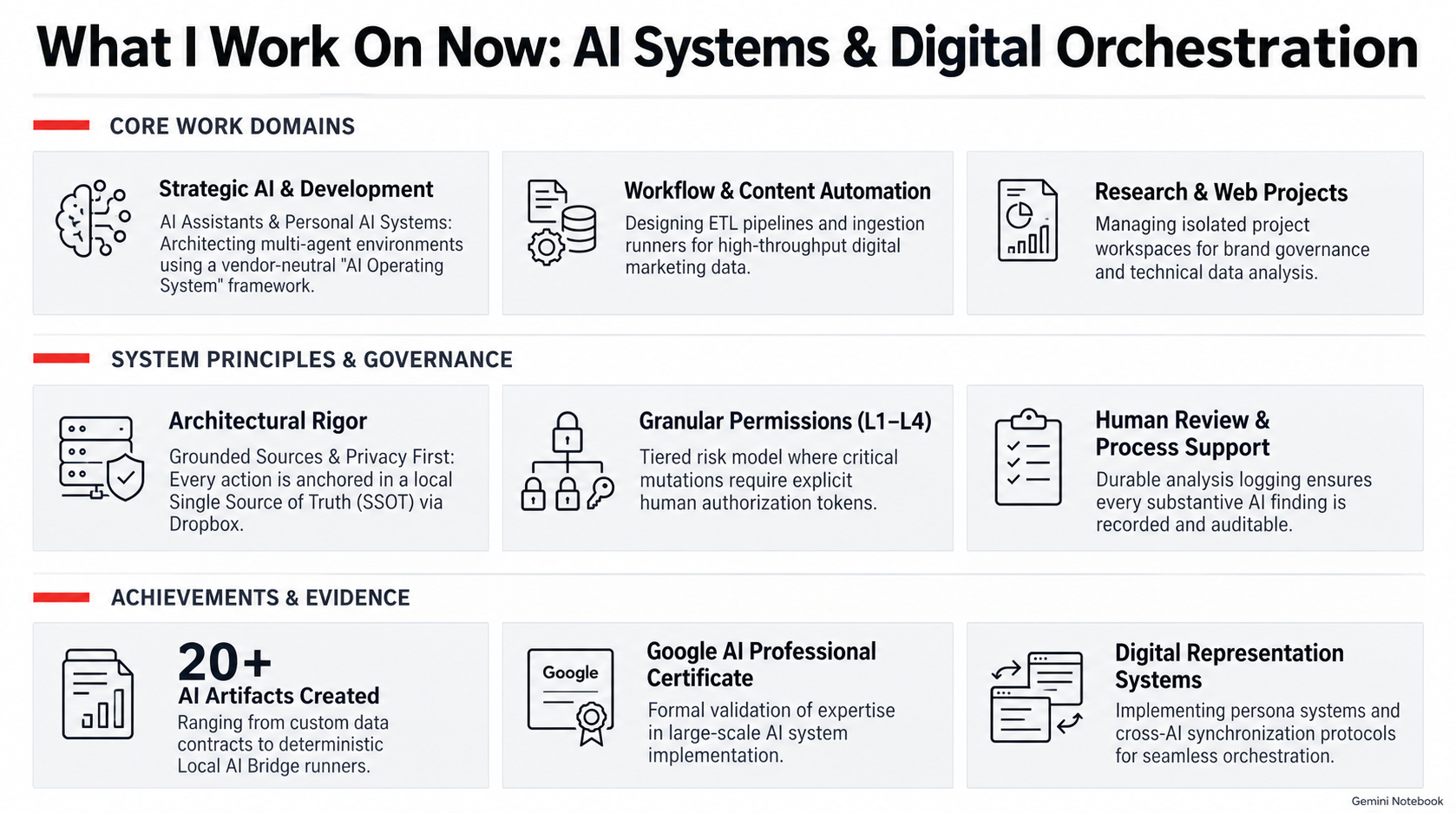
What I Work On Now: AI Systems & Digital Orchestration
CORE WORK DOMAINS
Strategic AI & Development
AI Assistants & Personal AI Systems: Architecting multi-agent environments using a vendor-neutral "AI Operating System" framework.
Workflow & Content Automation
Designing ETL pipelines and ingestion runners for high-throughput digital marketing data.
Research & Web Projects
Managing isolated project workspaces for brand governance and technical data analysis.
SYSTEM PRINCIPLES & GOVERNANCE
Architectural Rigor
Grounded Sources & Privacy First: Every action is anchored in a local Single Source of Truth (SSOT).
Granular Permissions (L1–L4)
Tiered risk model where critical mutations require explicit human authorization tokens.
Human Review & Process Support
Durable analysis logging ensures every substantive AI finding is recorded and auditable.
ACHIEVEMENTS & EVIDENCE
20+ AI Artifacts Created
Ranging from custom data contracts to deterministic Local AI Bridge runners.
Google AI Professional Certificate
Formal validation of expertise in large-scale AI system implementation.
Digital Representation Systems
Implementing persona systems and cross-AI synchronization protocols for seamless orchestration.
Built Alongside the Web
I first went online in 1995. I built my first website in 1997 — before Google existed.
By March 2007, I was working professionally in SEO, online advertising and end-to-end internet marketing. The first iPhone had not yet gone on sale. Instagram did not exist. Google Ads was still AdWords.
I did not enter digital marketing after the industry had matured. I grew with it.
In those early years, digital work was much less divided into specialties. SEO, advertising, websites, content, analytics, e-commerce, reputation and conversion often belonged to the same problem. Some of the work I was doing would only later acquire the names and disciplines we use for it today.
But an important part of how I think was formed even earlier — before the web became part of my professional life.
My education gave me a strong foundation in mathematics, physics, economics, logic and statistics. That shaped the way I approach complex systems. I tend to look for structure beneath the surface: variables, constraints, probabilities, incentives, dependencies, feedback loops and cause-and-effect relationships.
Not everything involving people or markets can be reduced to a formula. Human behavior is not deterministic. But digital systems are built on logic, and business decisions happen under constraints that can be measured, modeled and tested. Statistics helps distinguish a real signal from noise. Economics explains incentives and trade-offs. Logic helps expose contradictions. Mathematics teaches you to look for the structure of the problem before reaching for an answer.
That foundation has probably been more valuable to me than any individual marketing tool or platform.
Years of watching search engines, platforms, audiences, algorithms and business models evolve also taught me something harder to formalize: how to feel the network as a system.
I do not mean predicting the future. I mean recognizing relationships, weak signals and changes early enough to experiment before a new pattern becomes obvious.
That is one reason I rarely start by asking what competitors are doing or which playbook is currently considered best practice. Copying a successful strategy means starting from a position someone else has already reached.
The fundamentals matter enormously. Understand the user. Understand the product. Understand incentives, intent, distribution, measurement and economics.
But tactics have a much shorter life.
Some approaches I experimented with later became common practice months or years afterwards. Others failed — which is equally important. Working ahead of established patterns requires testing, measurement and a willingness to abandon an idea when reality proves it wrong.
This is also why traditional marketing seminars were never a major part of how I learned. By the time a successful tactic has been discovered, refined, packaged into a presentation and taught at scale, the environment that made it successful may already be changing. I learned more by working directly with real systems: observing them, testing hypotheses, measuring outcomes and adapting.
Over the years, that work expanded across SEO, PPC, paid social, SMM, PR, web development, ASO, analytics, project and marketing management, automation and, more recently, applied AI and AI-assisted operating systems. Since 2010, much of it has been connected to companies operating in the U.S. market.
Platforms appeared, dominated, declined or disappeared. Tools changed. Interfaces changed. Entire professions appeared around problems that once had no established name.
The underlying principles changed much less.
That is why I try not to master playbooks.
I try to understand systems.
CONNECTED SYSTEMS
Experience built across connected systems
I see these areas as connected systems rather than separate lists of services:
Applied AI and automation
research, planning, analysis, content workflows, assistants, personal AI systems and repeatable automation with human review.
Digital acquisition and communication
SEO, PPC, paid targeting, SMM, PR and ASO, connected to the actual product, audience and evidence available.
Web and content systems
websites, web development, information architecture and content structures designed to remain understandable and maintainable.
Research and verification
OSINT, information-security awareness, source checking and a clear separation between confirmed facts, interpretations and open questions.
Management and integration
project management, marketing leadership and strategic integration across business goals, technology, content and operating processes.
I am a war veteran, volunteer, with combat experience. I keep that context intentionally high-level and do not publish operational or other sensitive details.
WORKING PRINCIPLES
How I work
Problem before tool
Evidence before confidence
Privacy and control by design
I start with the problem, the context and the limits before selecting a tool. I distinguish facts from assumptions, prefer repeatable processes to one-off tricks, and test outputs instead of treating fluent language as proof.
I also work within clear information boundaries. Client information is protected by default. Personal data, private system architecture and access details do not belong in public examples. When a case cannot be shown safely, I would rather explain the method without inventing a result or exposing someone else’s work.
That same approach shapes Stariy.com: practical explanations, explicit evidence, visible uncertainty and corrections when new information changes a conclusion.
INTEGRATION
Building and teaching through WeTrueGun
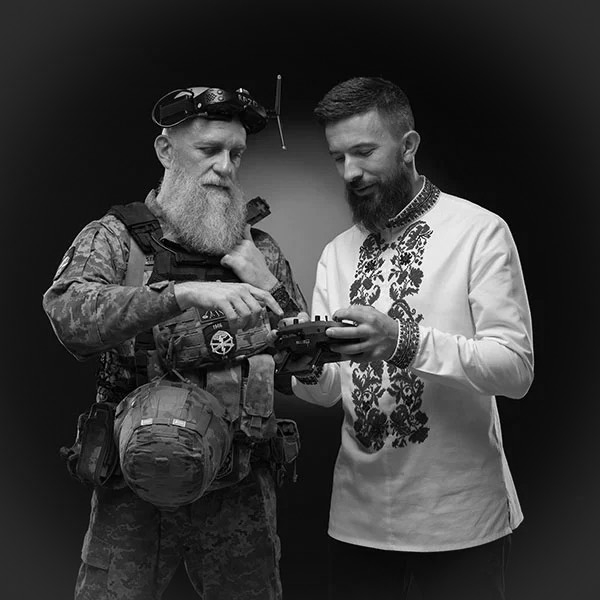
I am the founder and leader of WeTrueGun. This work brings together technology, education and management: translating complex technical subjects into structured learning, coordinating people and processes, and building systems that have to work beyond a presentation.
This is included as a high-level example of integration. Operational details, protected training information and sensitive context are intentionally outside the scope of this page.
CONTINUING STUDY
Education and continuing study
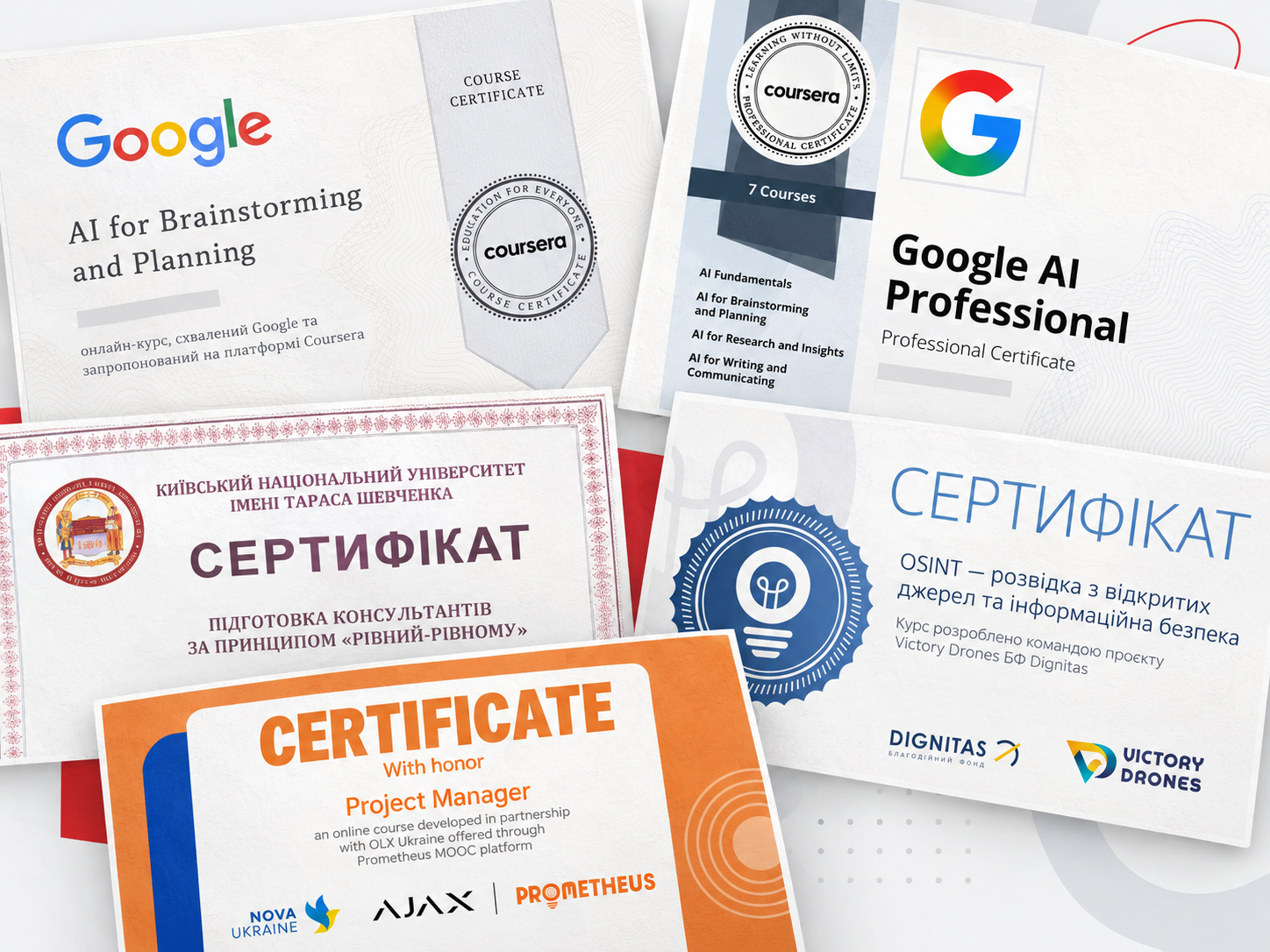
My formal education includes economics and law. I have also completed professional study in project management, Google AI, OSINT and information security.
That background helps me look at technology from more than one angle: incentives and business constraints, rules and responsibility, implementation, evidence and the people who have to use the final system. It does not imply current legal practice or licensed financial activity.
THE BLOG
What this blog is about
Stariy.com is my personal technology blog for practical work across several connected areas:
- applied AI, assistants and personal AI systems;
- workflow automation and repeatable operating processes;
- digital marketing, SEO and paid acquisition;
- websites, current WordPress work and content architecture;
- content systems and AI-assisted production;
- OSINT, research and information verification;
- project management and strategic integration;
- learning, reskilling and the lessons that come from working across disciplines.
I write about what changes between a demonstration and a dependable workflow: context, evidence, tools, permissions, evaluation, failure recovery and human responsibility. The goal is not to promote every new tool. It is to make complex systems easier to examine, use and improve.
Start with the latest articles, explore AI Systems, follow practical Workflows, or browse Technology Foundations and Reviews & Research.
The Story Behind Stariy.com
Stariy.com began as a technology blog about mobile phones, smartphones, gadgets, software and the internet. It combined device news and reviews with practical explanations of the technologies behind them. The earliest post preserved in the publicly available archive is dated 20 November 2007 and covers the Lenovo i909 gaming phone.
Over time, my interests changed. I became less interested in following the gadget market and shifted my attention to Travmatik, a Ukrainian project focused on firearms, shooting sport and safety, with news, reviews and a community forum.
Later, circumstances changed far more profoundly. The war that began in 2014 brought moves and military service. Russia’s full-scale invasion in 2022, followed by my service in the Armed Forces of Ukraine, made maintaining a personal blog a distant priority. That long pause was part of a changing life, not simply an abandoned publishing schedule.
This new version of Stariy.com is a different kind of project: an experiment in AI-assisted website construction. The Website Constructor workflow uses AI to carry out work ranging from development-staging setup to site structure, article drafting, visual preparation, SEO checks and iterative corrections. It draws on my experience, selected conversations with AI and authorized, anonymized context from practical work.
AI performs much of the execution, but it does not remove my role or responsibility. I set the direction, supply material, make editorial decisions and request corrections. The imagery includes both generated illustrations and real photographs supplied for the site. The process began with an initial brief and continued through refinement and testing.
I also plan to write some articles myself. The site is a place to explore technology and systems, and the way it is built is part of that exploration. Times change. Interests change. Circumstances change. This is the next chapter of the same website, not an attempt to pretend that nothing changed along the way.
