Cat Jam Is Reflection Beam: What Happens When Free Access Ends?
October 18, 2026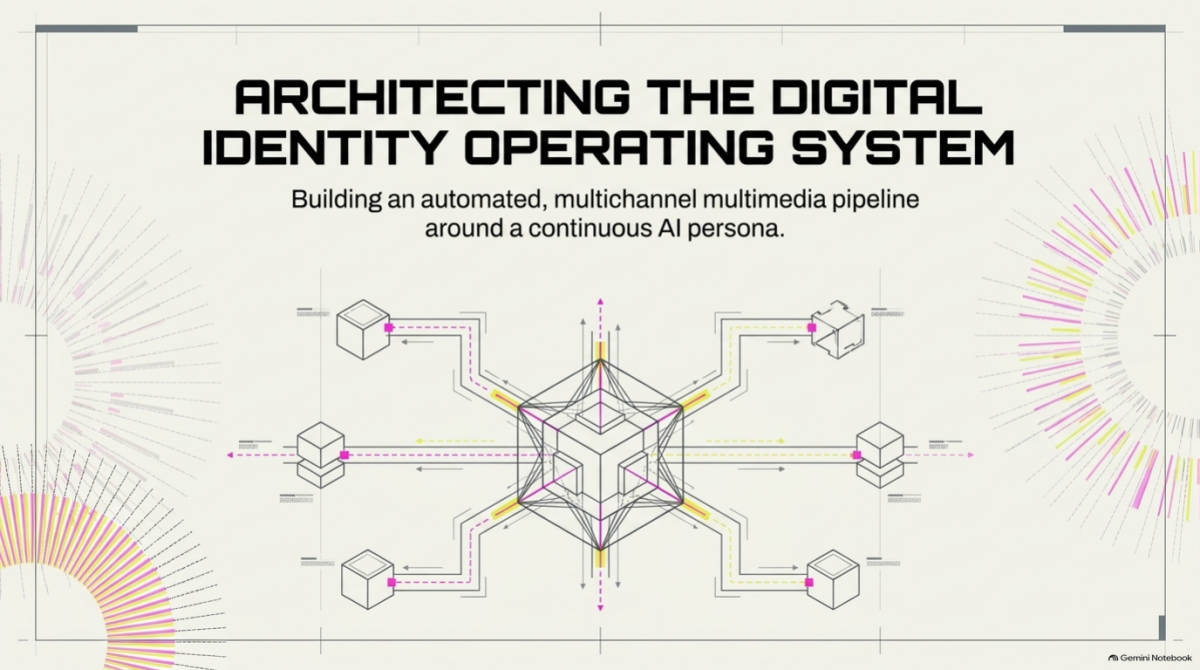
I did not start The Next Step Daily to build the next viral motivational account. I started it to test something more interesting to me: could I create a digital representation of a real person, give it a consistent identity and philosophy, and build an AI-driven production system around it?
The experiment went beyond generating a talking face. It connected content creation, video production, platform-specific publication, statistics analysis and the development of subsequent seasons. Posting was automated across Instagram, Facebook, TikTok, YouTube and LinkedIn. The publication text was generated differently for each platform. My participation was minimal.
That is the case I want to explain here: not a claim that an AI has become a person, and not a story about spectacular audience growth, but an implemented experiment in identity, creative constraints and a repeatable media-production loop.
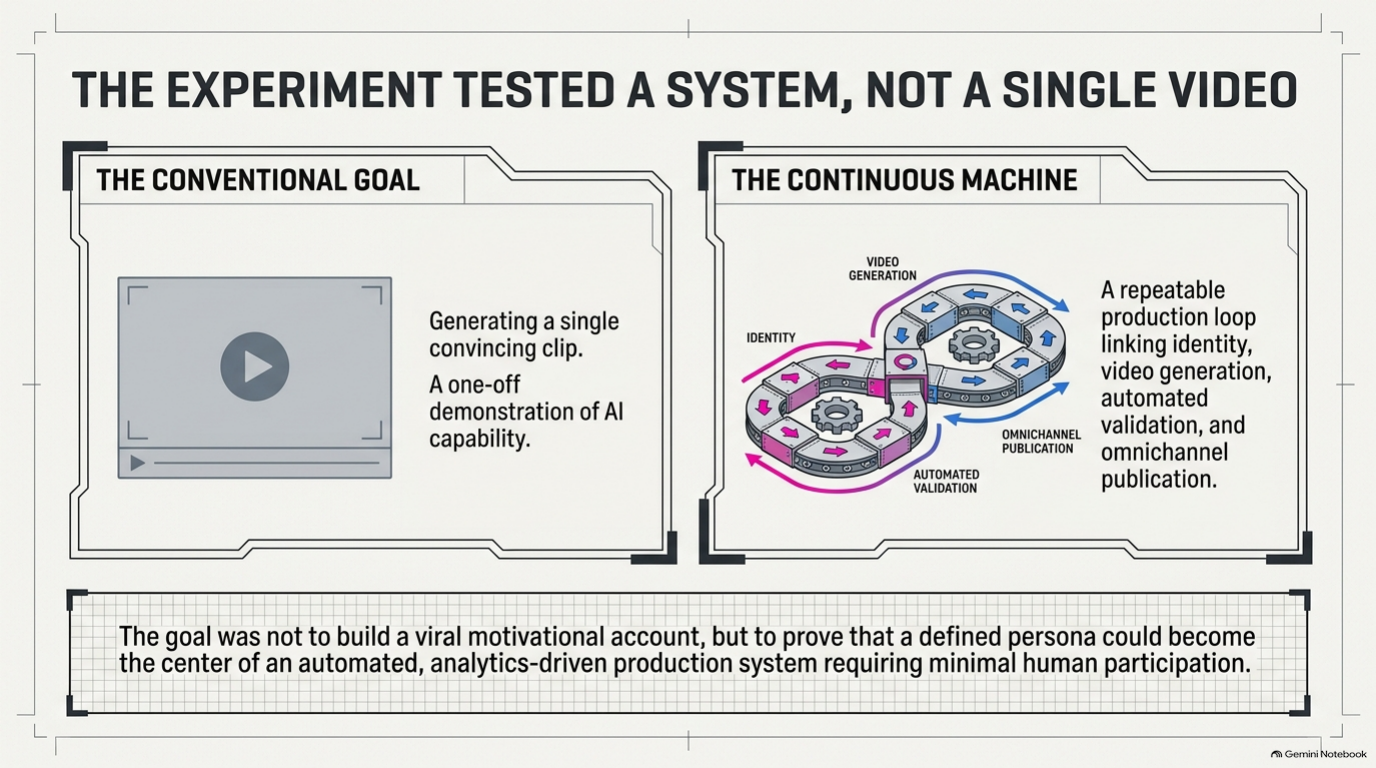
The experiment was about a system, not a single video
Making one convincing clip is a useful demonstration. Keeping a character recognizable across a series is a different problem. The face may remain similar while the language becomes generic. A voice may sound plausible while the delivery loses its restraint. Individual scripts can work on their own but repeat the same idea or contradict the direction of the season.
I wanted the production process to carry more than an appearance. It needed a reason for the character to speak, boundaries on what he would say and a way for one episode to belong to a larger body of work.
The subject was deliberately not selected as an obvious route to maximum views and likes. For me, this was an experiment in whether the production and distribution system could work with a coherent digital persona. Audience response mattered as feedback, but popularity was not the original definition of success.
TNSD was the first practical test and implementation of this production conveyor. Its direction deliberately ran against the popular coaching formulas and the kind of material designed to collect likes and go viral. Even so, it attracted views and subscriptions organically, without advertising. Those responses were a result to learn from, not the reason I built it.
DIOS is the identity framework; TNSD is the implementation
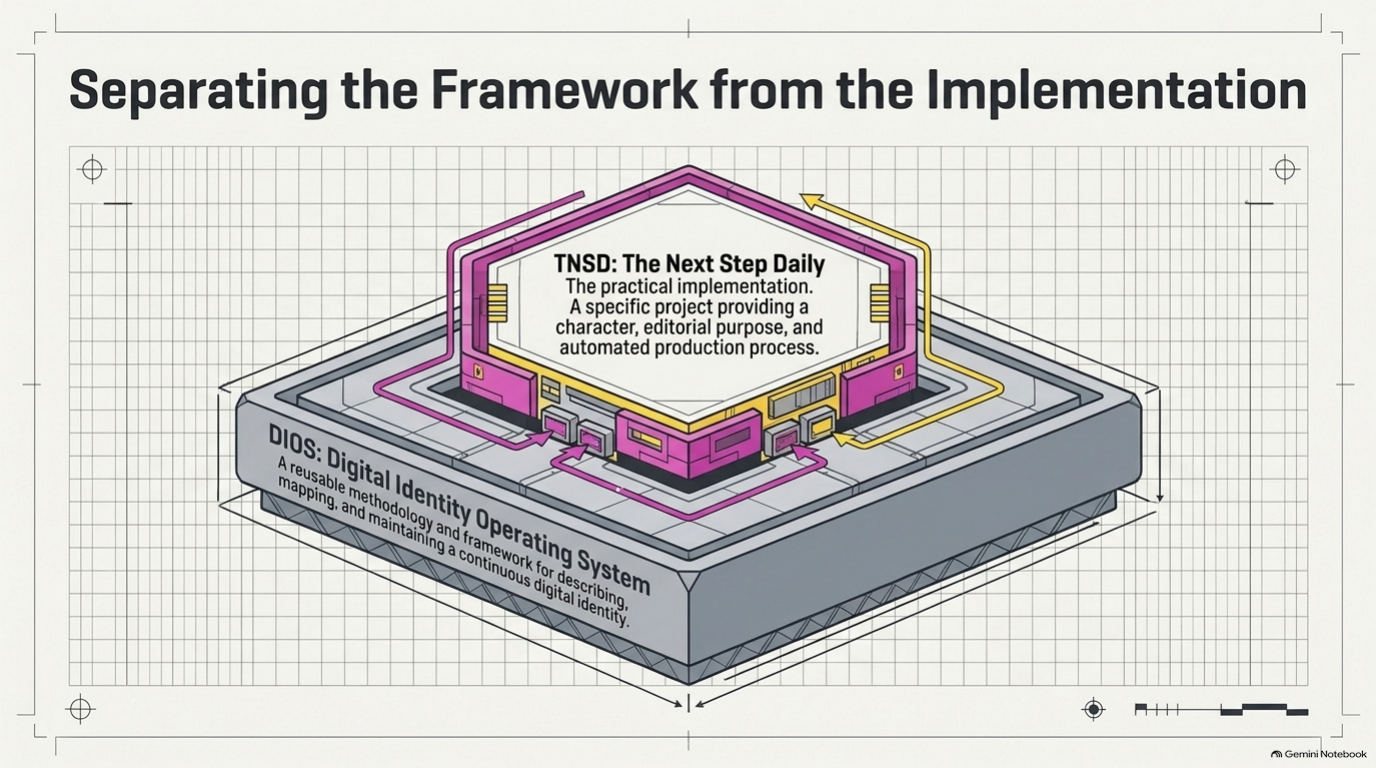
I use DIOS—Digital Identity Operating System—as the name for the methodology behind this work. It is a framework for describing and maintaining a digital identity, not an operating system installed on a computer.
The Next Step Daily, or TNSD, is a practical implementation. Keeping those two ideas separate matters: a reusable framework describes the identity dimensions and constraints; a particular project gives them a character, editorial purpose and production process.
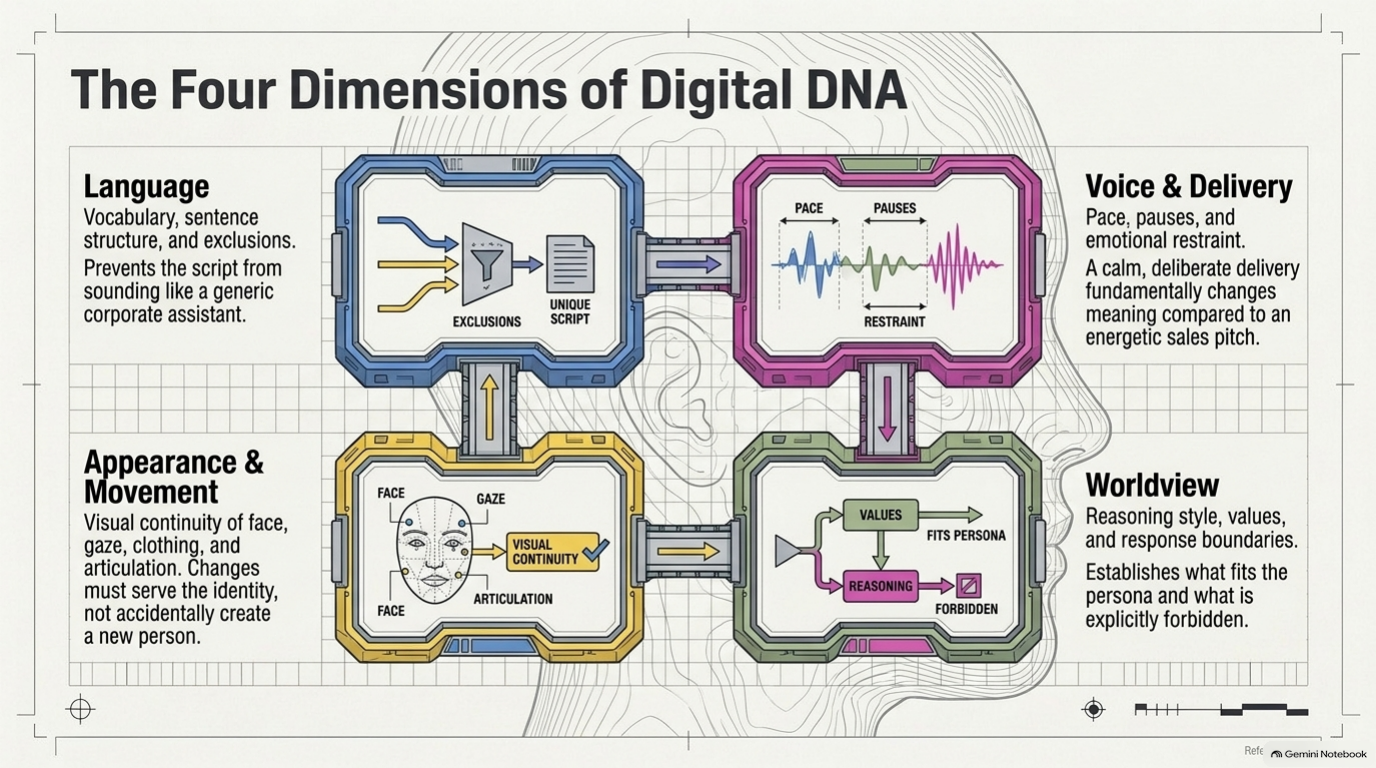
The framework uses four dimensions of what I call Digital DNA. This is a design term, not a biological claim or proof that a person’s complete mind has been reproduced.
Language
Identity appears in vocabulary, sentence structure, characteristic expressions and the things a person would avoid saying. A visually accurate avatar can still feel wrong if every script sounds like a generic corporate assistant. The language specification helps keep the writing recognizable instead of letting a model’s default style become the character.
Voice and delivery
A voice is more than its timbre. Pace, pauses, emphasis and emotional restraint affect how the words are understood. For this project, a calm, deliberate delivery belongs to the concept. An energetic sales pitch would change the meaning even if the transcript stayed the same.
Appearance and movement
Visual continuity includes the face, gaze, clothing, articulation and presentation. It is not a requirement to make every frame identical. It is a requirement that changes serve the same identity rather than accidentally creating a different person.
Worldview and response boundaries
The fourth dimension concerns the character’s reasoning style, values and response patterns. It defines what fits the persona and what does not. It does not establish that the system can make every judgement the real person would make, or that it has acquired that person’s experiences.
A philosophy gave the production process useful constraints
The Next Step Daily centres on responsibility, discipline, meaning and the next controllable action. Its recurring opponent is self-deception: the excuses and comfortable explanations that let a person avoid what they already know needs doing.
The character is not an idealized guru promising wealth or effortless transformation. The editorial direction is quieter and more demanding. It asks what remains within a person’s control and what the next honest action would be.
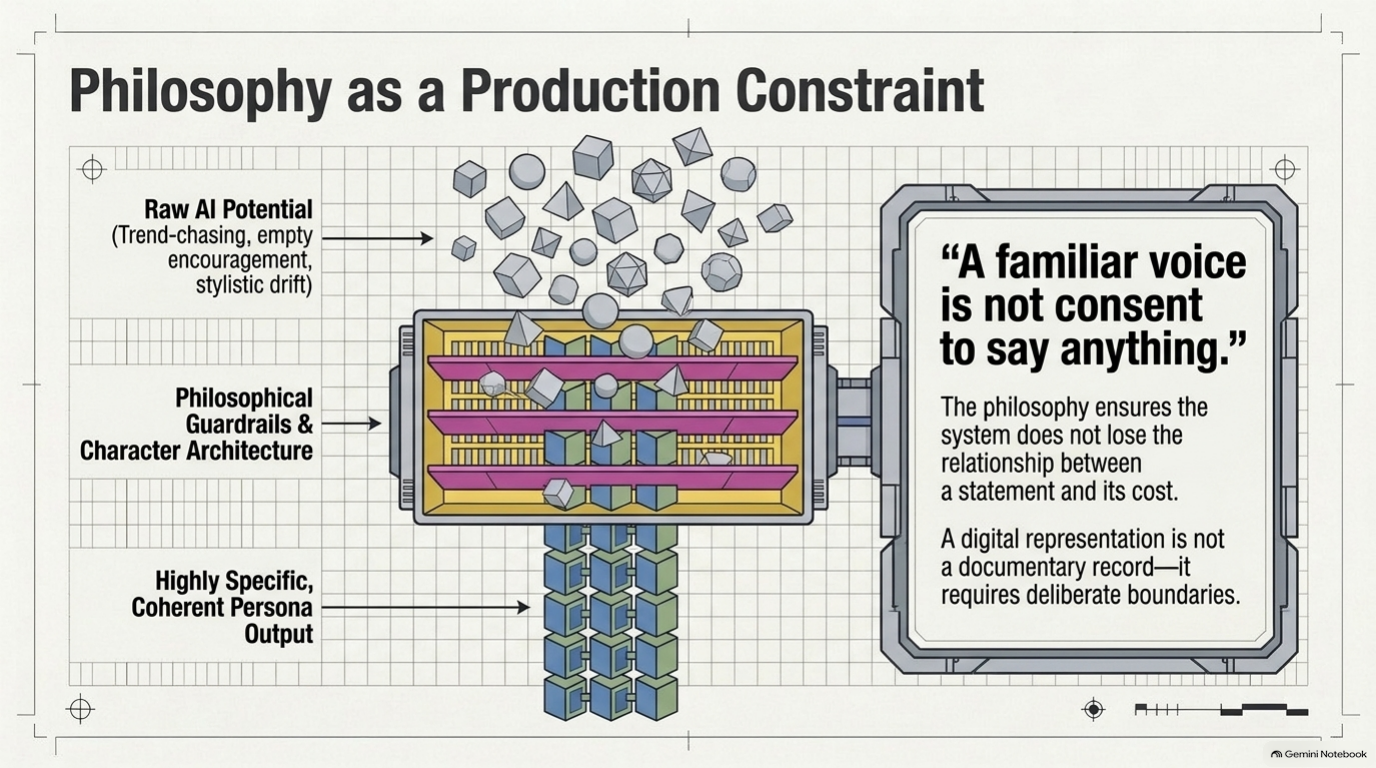
That philosophy is also a production constraint. A script can be fluent, polished and still be wrong for the project. If it becomes empty encouragement, chases a trend or loses the relationship between a statement and its cost, it no longer serves the concept.
This also creates an important disclosure boundary. A synthetic persona can deliver a scripted reflection without every first-person line being a literal event from my biography. A digital representation and a documentary record are not interchangeable. The finished media should be presented honestly as AI-created content.
Seasons made the content more than a queue of disconnected clips
The project organizes its ideas into seasons. The documented arc includes Foundation, Ownership, Fear, Focus, Habits and Execution, followed by Endurance, Integrity and Alignment. These are connected themes rather than interchangeable labels placed on individual posts.
The documented weekly model, introduced from Season 05, uses twelve episodes per season. That is the project’s production design, not a claim that twelve is an optimal publishing frequency for every audience or platform.
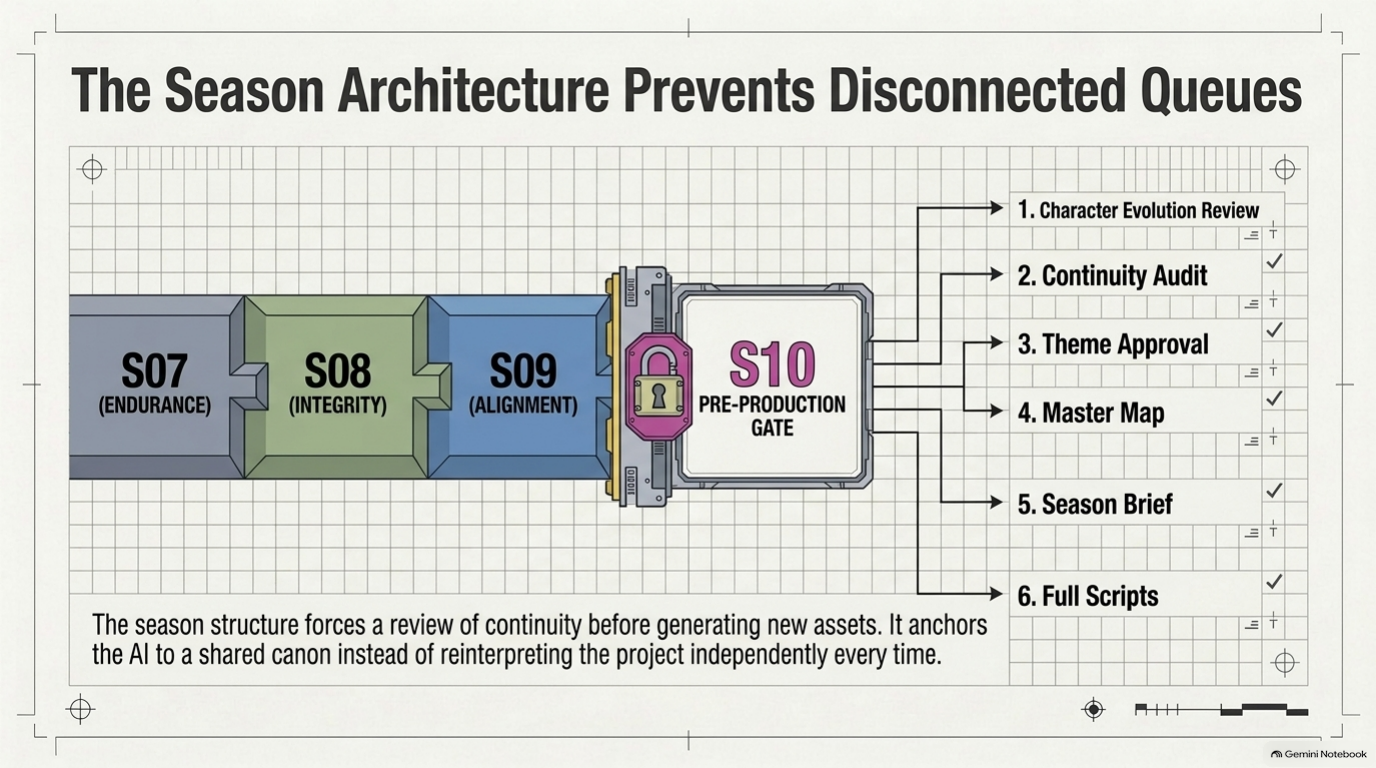
A season provides a bounded unit of work: a theme, a sequence of episodes and an opportunity to review what happened before creating the next part. It helps distinguish developing an idea from asking an AI to produce another set of loosely related quotations.
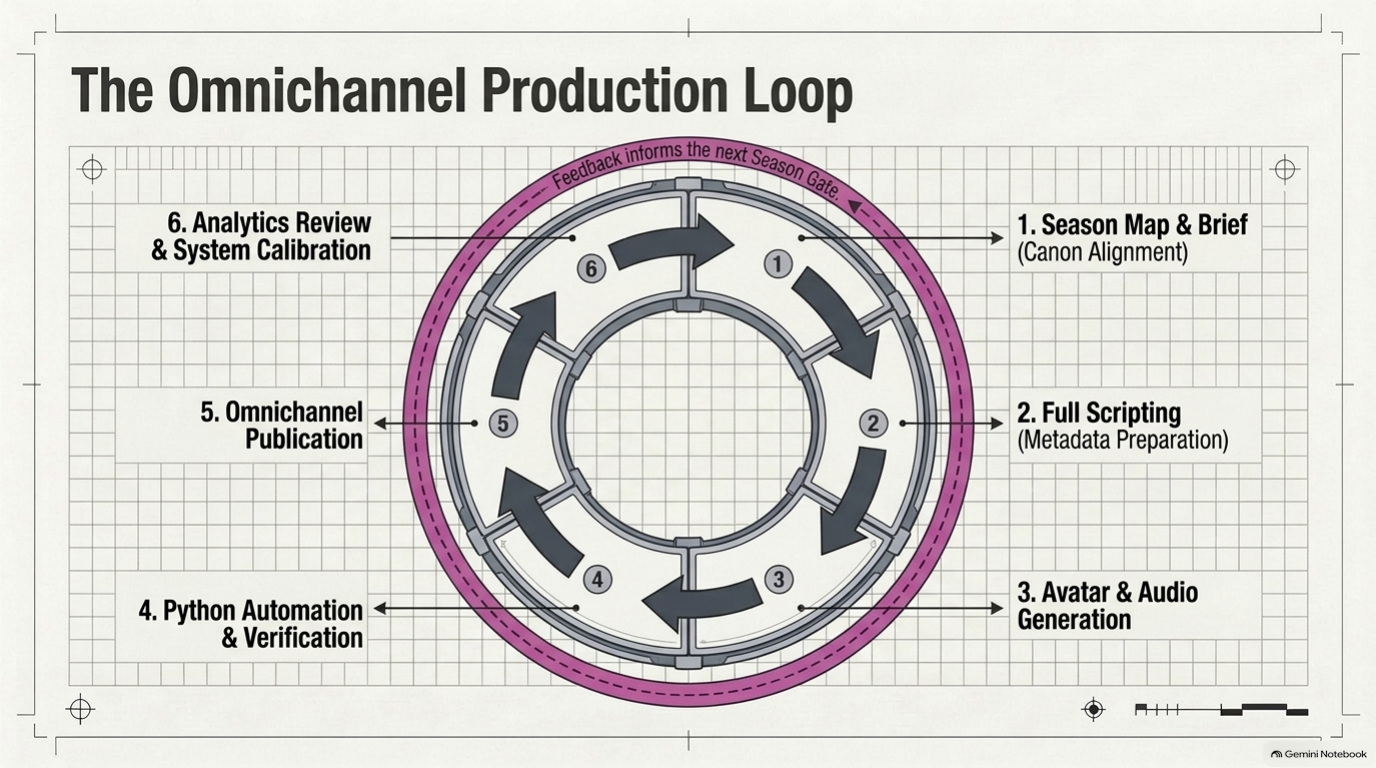
The production sequence moves from a season map to a brief and full scripts, then into covers, video and captions, and finally into platform-ready publication data. That structure gives the automated stages a shared reference instead of leaving each tool to reinterpret the project independently.
The tools had different jobs
This was not one chatbot doing everything inside a single conversation. It was a workflow connecting AI services with ordinary software, structured files and publishing tools.
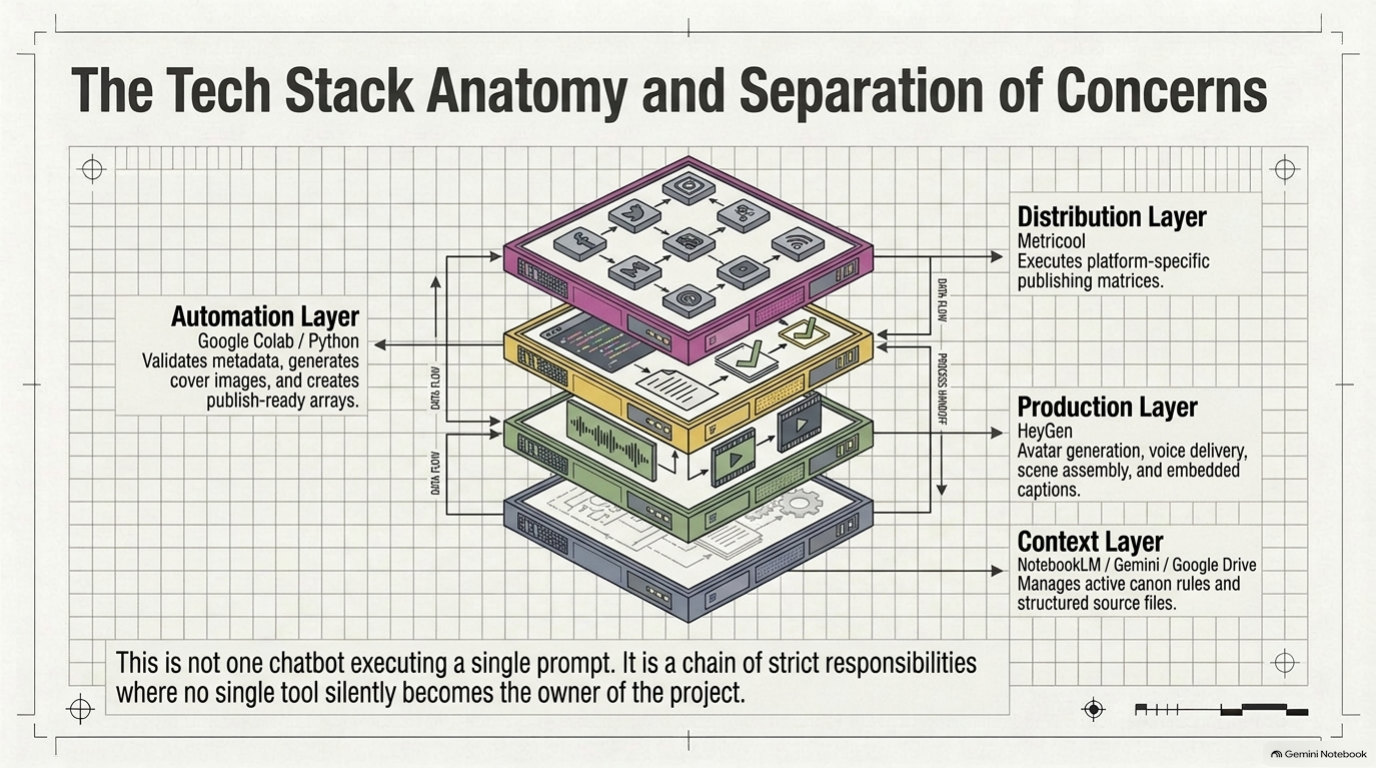
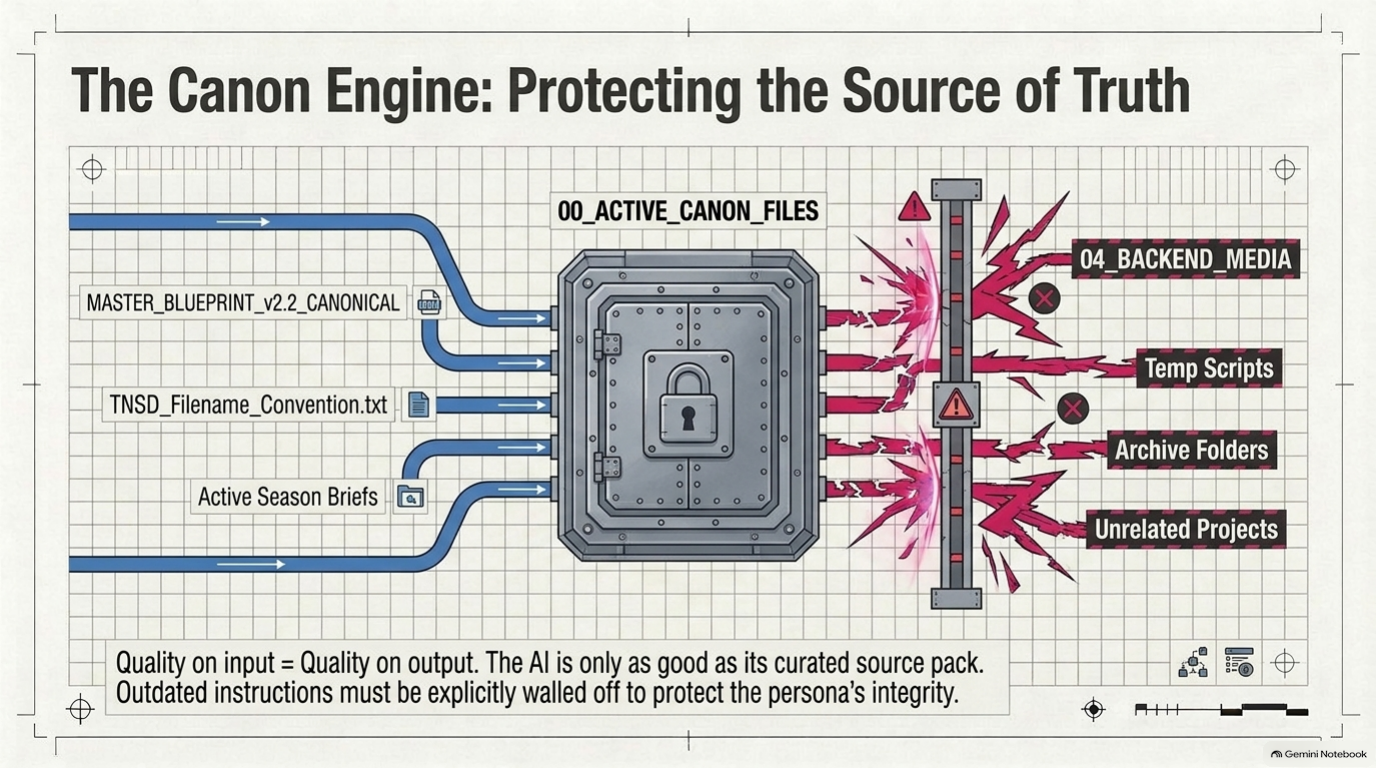
NotebookLM and Gemini source packs supported work with selected project context. Their role in the documented setup was to keep the relevant canon and production material available without treating every file in an archive as an equally authoritative instruction.
HeyGen handled the project’s avatar/video production, voice and delivery, assembly and embedded captions. The relevant output was a publication-ready episode, not merely an avatar asset waiting for an unspecified editing stage. CapCut was not a mandatory step in the active standard workflow.
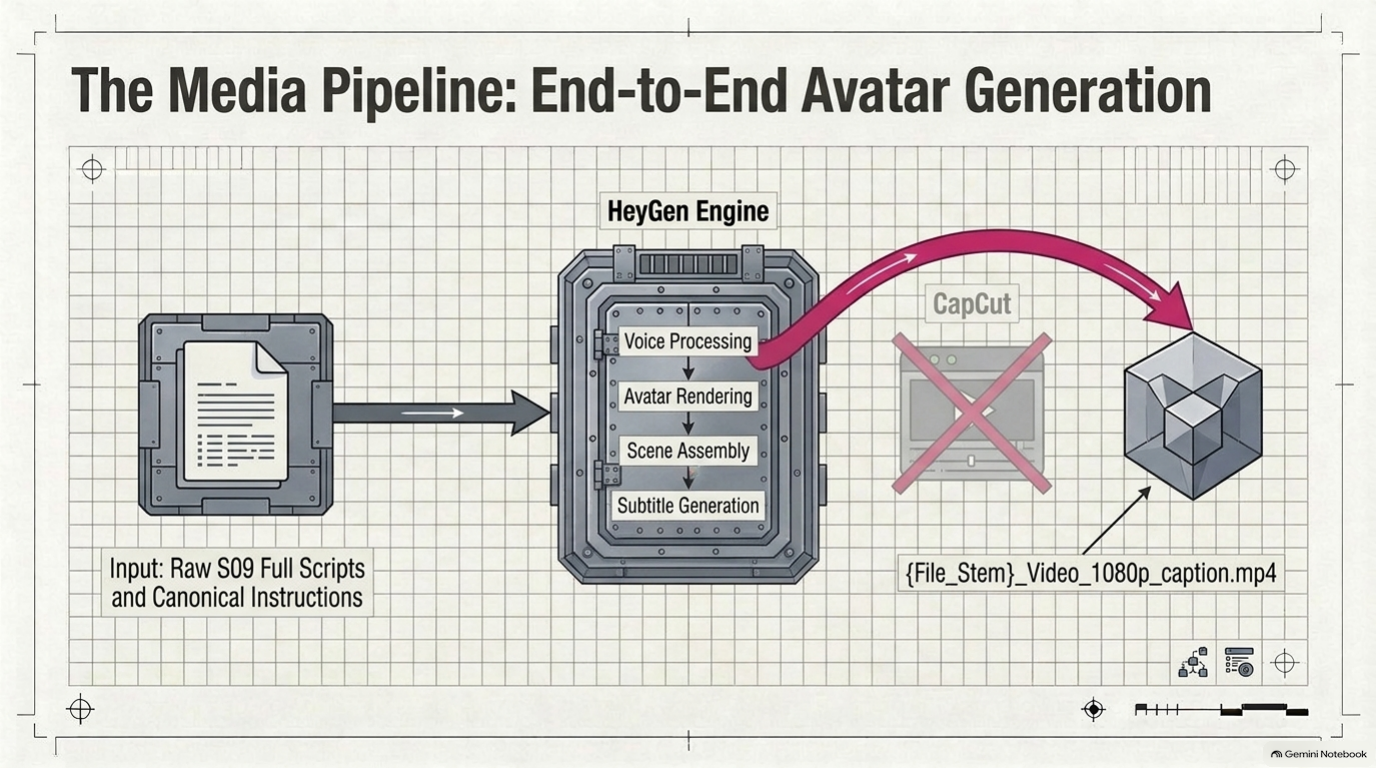
Google Colab and Python supported automated cover generation and the preparation and validation of publishing data. These stages connected episode metadata with the required assets and import outputs. This is a description of my project setup, not a universal claim about what every account or version of those services can do.
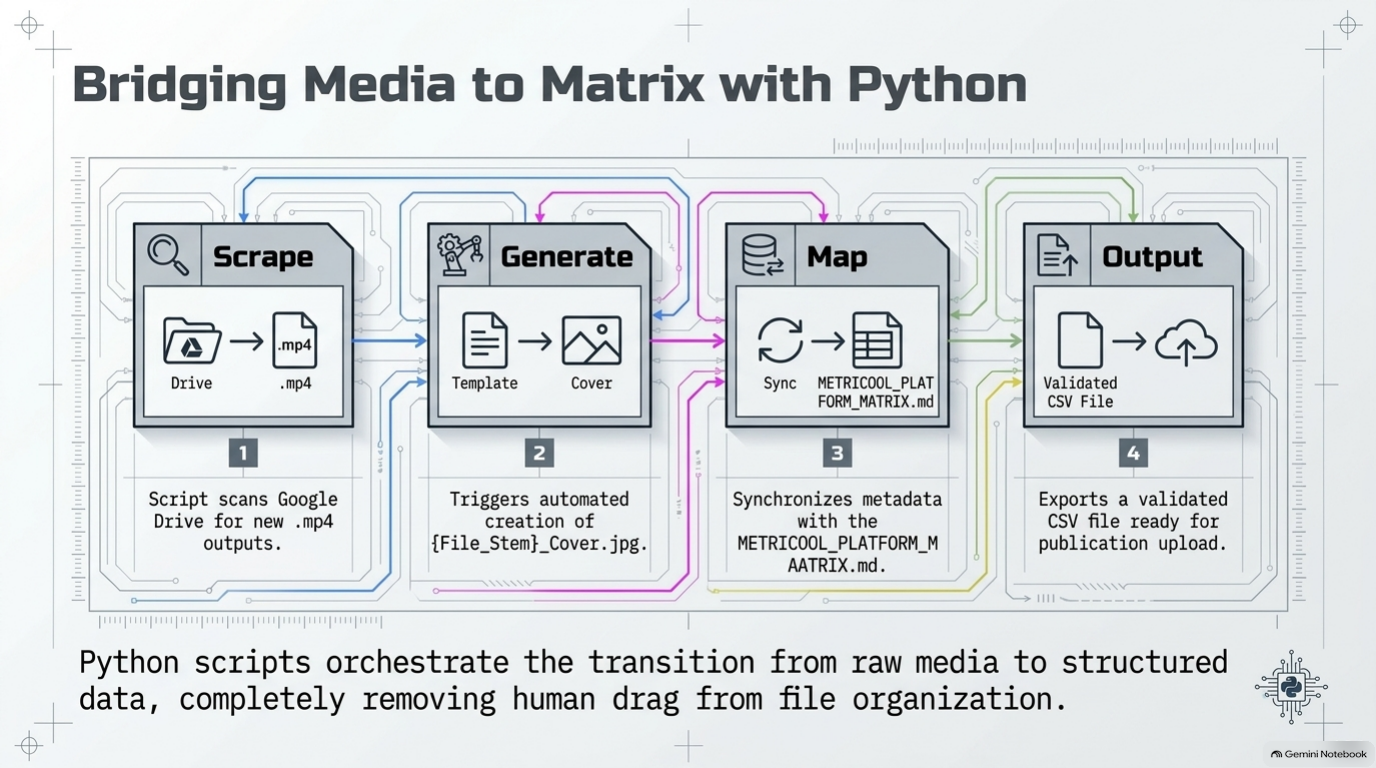
Google Drive and Google Sheets provided asset organization and control information. Metricool handled the publishing side of the workflow. Keeping episode identity, media and publication records aligned mattered just as much as producing the video itself.
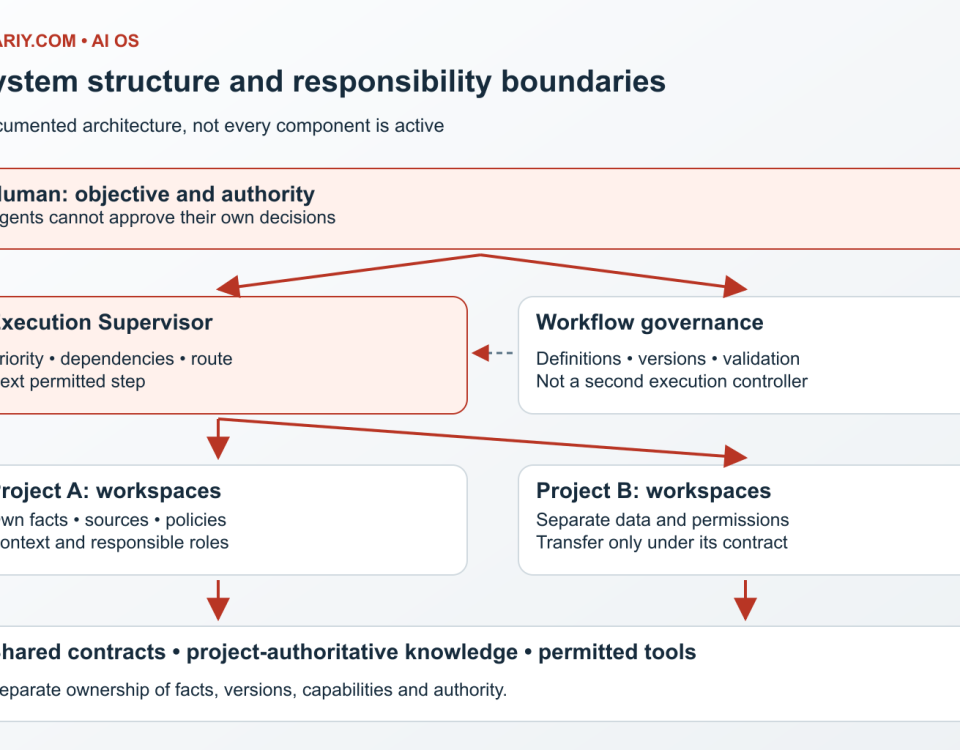
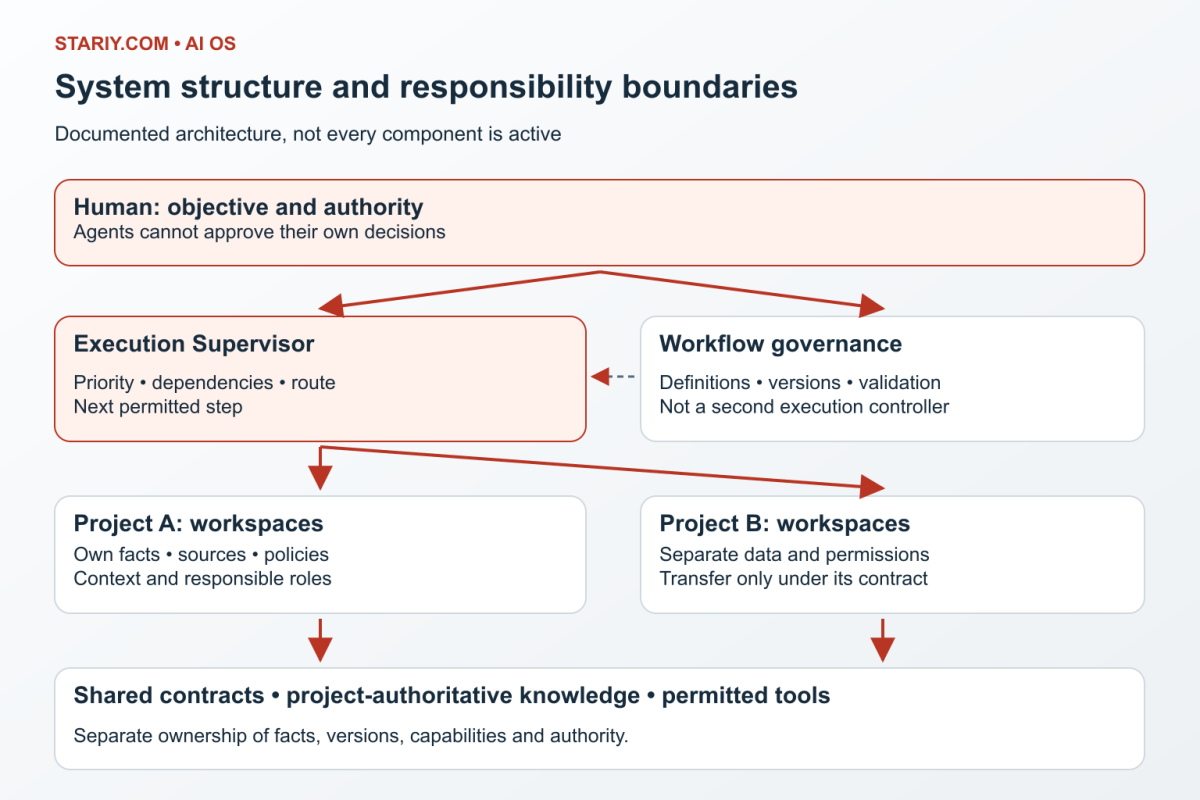
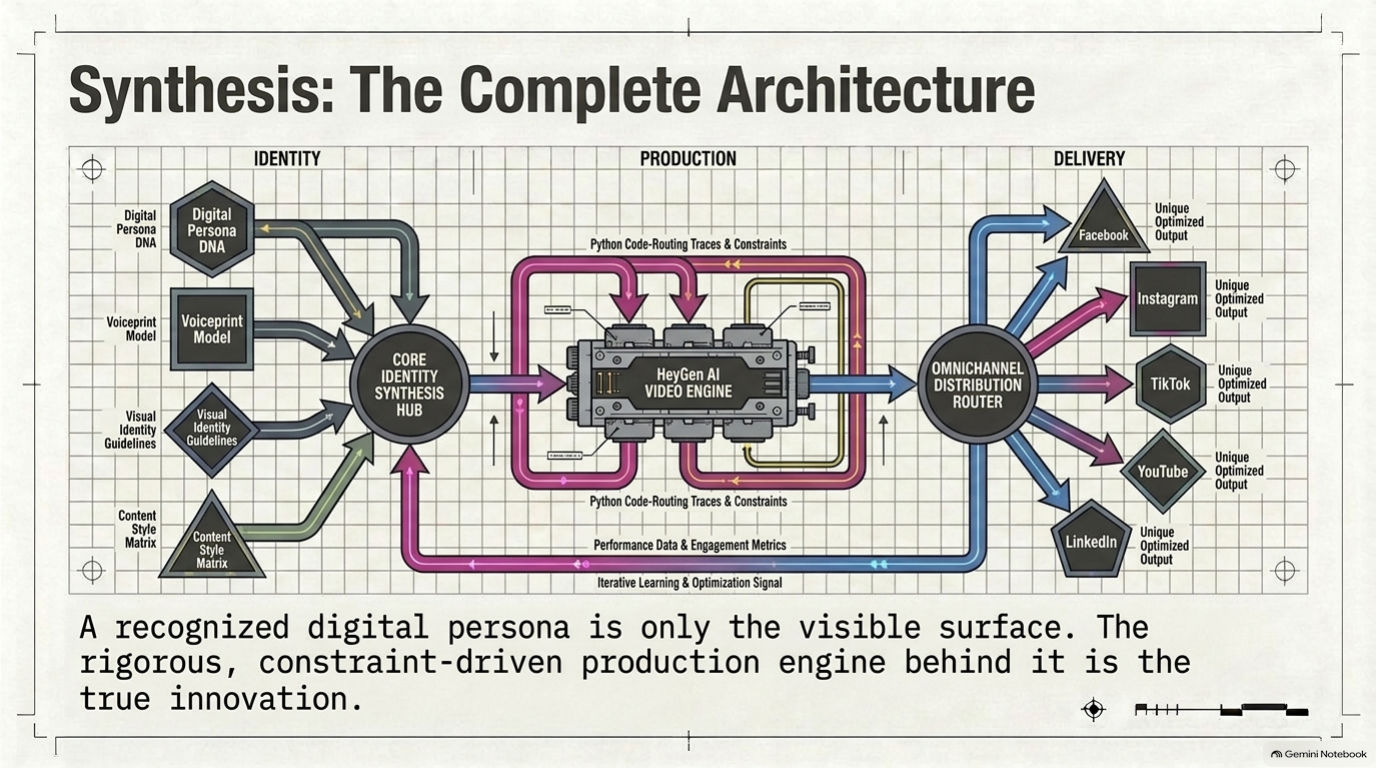
A useful way to read the architecture is as a chain of responsibilities: identity and editorial context, season and script, media production, asset checks, platform-specific publication, and feedback. Each stage needs the right inputs; none should silently become the owner of the whole project.
One episode became five platform-specific publications
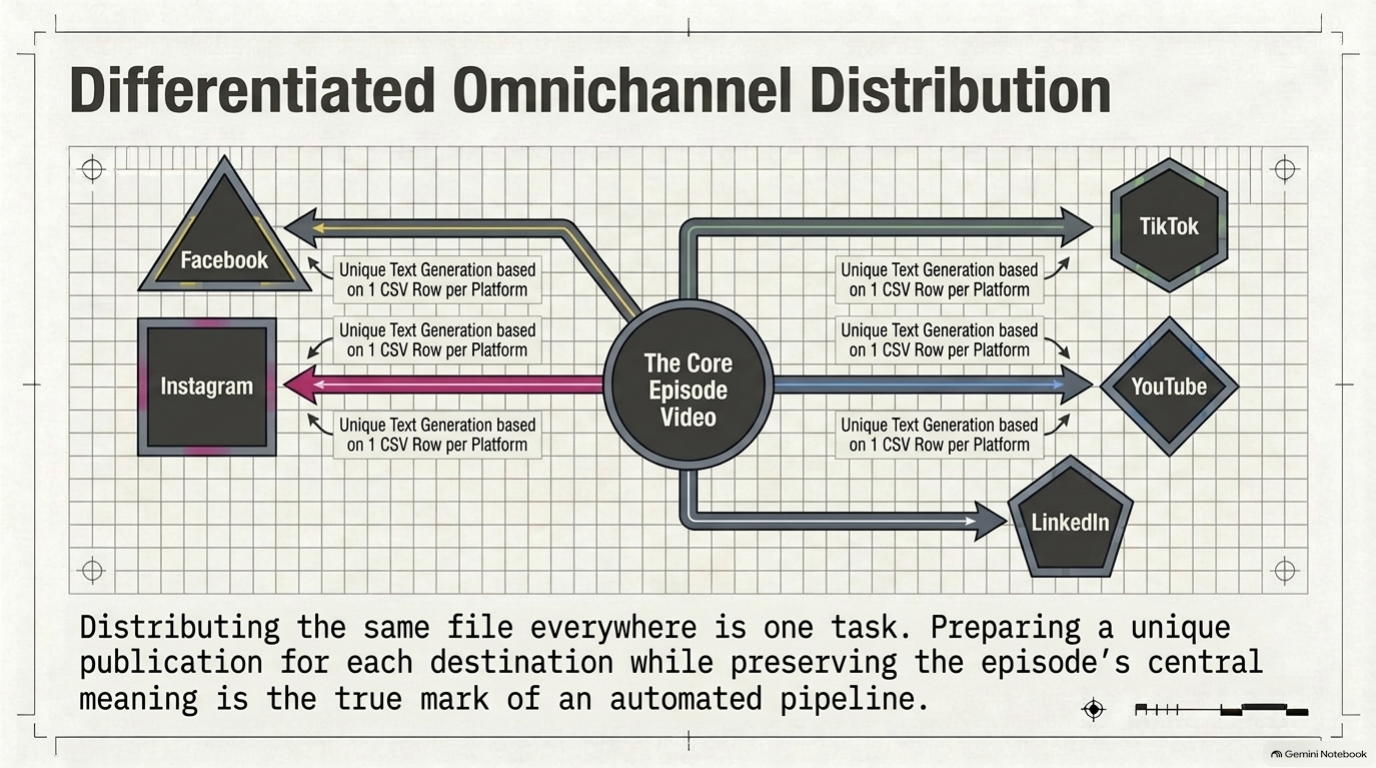
Posting was automatic on Instagram, Facebook, TikTok, YouTube and LinkedIn. However, the text was not simply copied unchanged into five destinations. Different publication-text formats were generated for the different platforms.
That distinction is easy to miss when describing automation. Distributing the same file everywhere is one task. Preparing a publication for each destination while preserving the episode’s central meaning is another.
In this case, an episode was the shared content unit, while the publication layer created platform-specific text. I am not claiming here that every video was independently reformatted, translated or optimized for every platform. The confirmed distinction is the automated distribution and the different text formats.
The operational model also separates an episode from a platform post. One episode can have several publication records. Keeping that relationship explicit makes it possible to discuss which platform carried which output without confusing a prepared file, a scheduled item and an actual publication.
Analytics fed the next production cycle
The automated process did not end when a post was published. It also analysed platform statistics and used that analysis in creating subsequent seasons. My involvement in this overall process remained minimal.
That closes the loop between production and development. Instead of treating analytics as a separate report that sits outside the creative process, the system uses audience response as an input to what comes next.
There is an important boundary here: feedback should inform the next season without silently replacing the project’s identity. A popular episode is not, by itself, a reason to turn a restrained character into a different kind of presenter. Performance and editorial coherence answer different questions.
This article is an account of my experiment, not an independent audit of every execution. I am not attaching an invented percentage of autonomy, hours saved or return on investment to it. Minimal participation does not mean that nobody designed the system, set its boundaries or remained responsible for what it published.
The platform is still an external dependency
Even a carefully designed production loop cannot control the platforms it publishes to. Bugs, unstable platform behaviour and support that fails to resolve a problem can derail the best plans and forecasts. A dependable internal process does not make an external service dependable.
I have a separate story to tell about Meta and my experience with its support. I plan to return to that case in another article. It is a reminder that a production system also has to account for what happens when the platform itself lets you down.
See the public output
If a preview does not load, open the example on YouTube, Instagram or Facebook.
The first Facebook episode and the first Instagram publication provide public examples of the experiment. They are starting points for seeing the output, not a claim that these were the most-viewed episodes.
I also described the project publicly in my launch post on LinkedIn, including its role as an experiment in AI-assisted production, automation and scheduling.
The videos are useful evidence of the published media. They cannot, on their own, establish how every backstage step ran. That is why the public examples and the explanation of the workflow belong together.
What I wanted this experiment to demonstrate
The interesting result was not just that AI could generate a person speaking. It was that a defined persona could become the centre of a repeatable system: a philosophy, season structure, production workflow, differentiated distribution and an analytics-driven continuation.
I see this as a practical DIOS experiment, not a finished answer to every problem of digital identity. Recognizable appearance is not a complete personality. A familiar voice is not consent to say anything. Automation is not the same as responsibility disappearing.
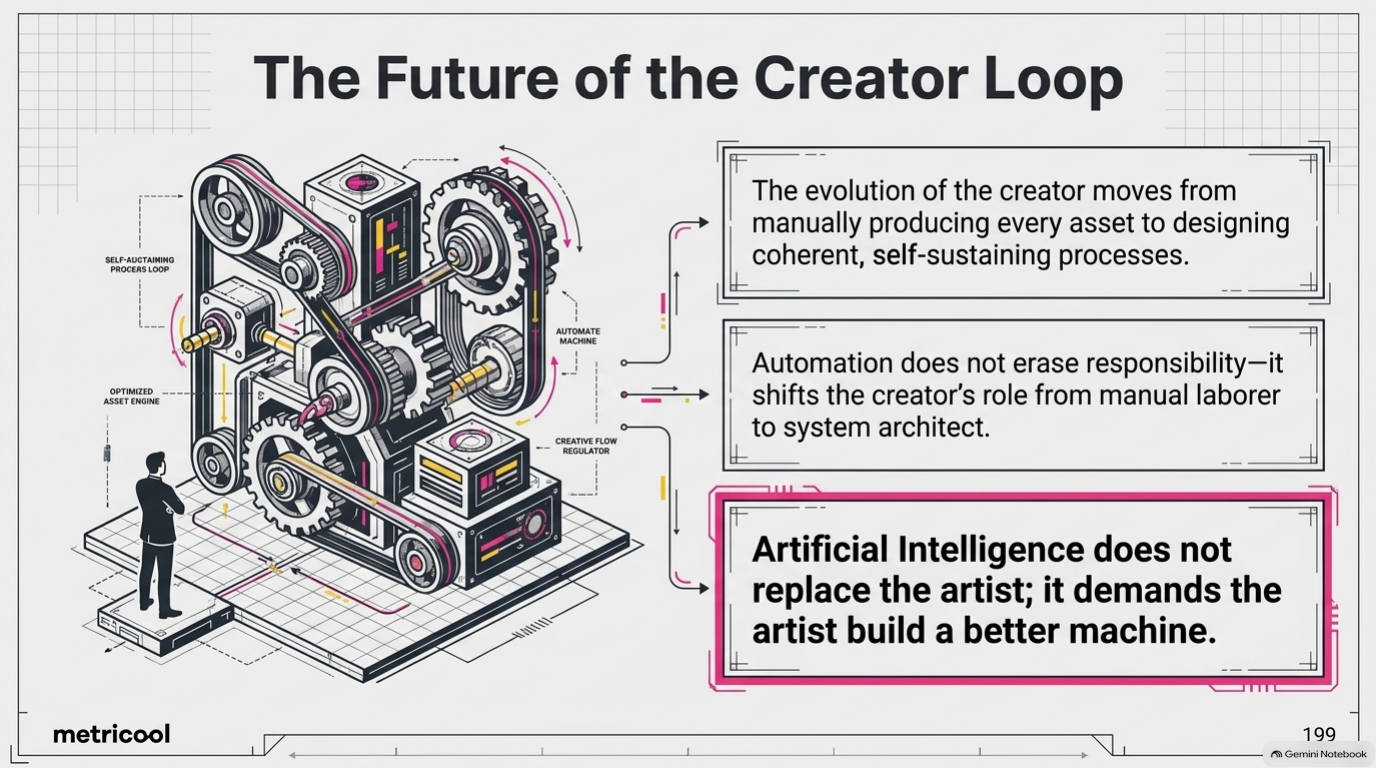
The broader question is whether a creator can move from manually producing every item to designing a coherent process that carries an idea through to publication and learns from the response. The Next Step Daily was my way of testing that question with a real project and public output.
The digital persona was the visible part. The production system behind it was the experiment.