Does Your Agent Remember—or Just Keep Files? Vercel Drives Explained
October 18, 2026
Cat Jam Is Reflection Beam: What Happens When Free Access Ends?
October 18, 2026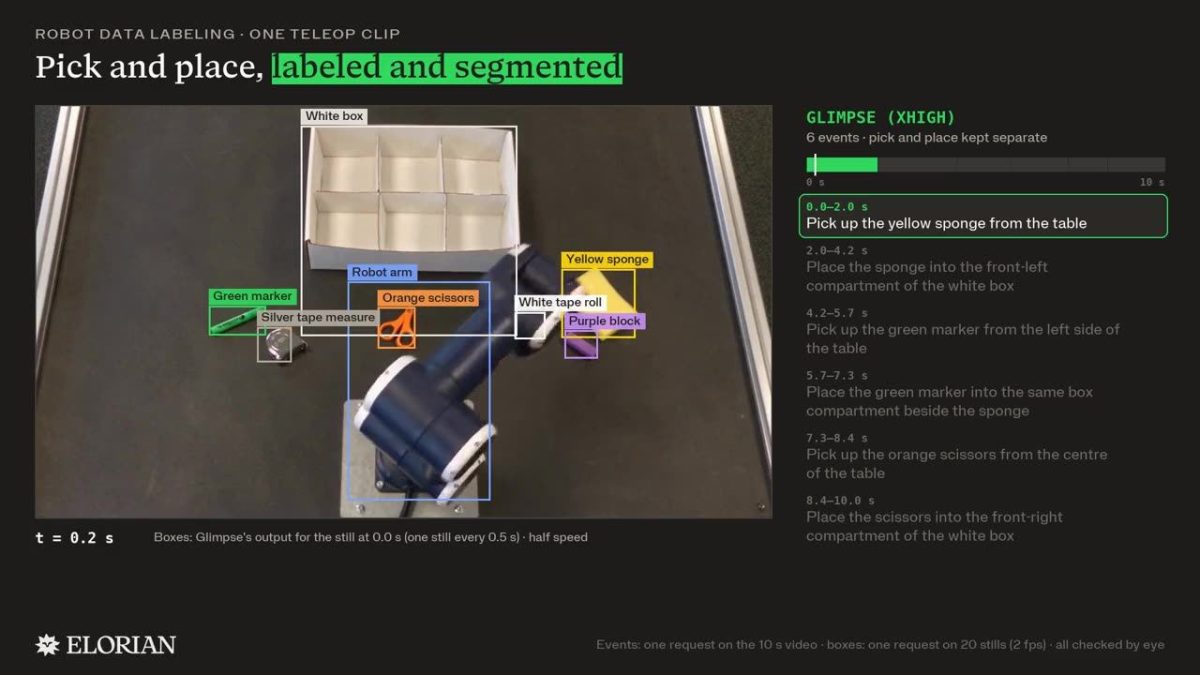
Demo still: Elorian. Vendor-provided example; not an independent test or robot-safety validation.
Open the full-size illustration (use your browser’s image zoom for small labels).
A box slides across a bench and falls out of view. A fluent video description might say that a worker knocked it over. Yet the recording may show neither a hand touching the box nor what happened beyond the frame. Recognizing a scene and explaining its cause are different achievements.
Elorian Glimpse offers a timely way to examine that distinction. The useful question is not whether an AI can produce a convincing account of a clip. It is which parts of that account can be traced to visible evidence, and which remain uncertain.
What the product description establishes
Vercel’s Glimpse model page, checked on October 18, describes Elorian’s model for image and video reasoning. It lists uses including chart analysis, captioning and robotics-related work, and describes reasoning about movement and spatial relationships. These are provider claims, not findings from our own video tests.
A multimodal model works with more than one kind of input or output. Computer vision concerns extracting information from images or video. Visual reasoning goes further: relating what is seen to a question, such as whether the same object remains visible or which observation supports a conclusion. Those descriptions do not by themselves establish reliable physical understanding.
Ask for observations before explanations
For an invented annotation task, separate three fields: what is visible, when it is visible and what cannot be determined. “A box moves left between these frames” is an observation to inspect. “The worker caused the fall” is a causal explanation requiring additional support. Do not quietly promote the second into a fact because it makes a more satisfying story.
Give reviewers timestamps or frame references that can be opened in the original recording. Where the interface permits it, ask for the evidence location alongside the proposed label. Then check that location yourself. A timestamp in an answer is not proof that the cited frames contain the claimed event.
Keep the original clip, any extracted frames and the transformation history linked. Resizing, cropping or sampling can remove the very detail the question depends on. Provenance is especially useful here: a reviewer should be able to tell which input actually reached the model.
Missing frames can change the question
Imagine reviewing an object handoff. One view shows a person holding a package; a later view shows another person holding it. That does not establish the exact handoff time or exclude an intervening event. The answer should reflect the evidence available, not silently assume continuous observation.
Check the actual endpoint’s accepted video format, duration and sampling behaviour before designing an evaluation. A large context limit is not a guarantee that every frame is inspected at the detail you need. This article does not verify Glimpse’s complete video-input limits or any specific sampling implementation.
Useful evaluation includes reasons to abstain
Build a small, carefully labelled set around the intended task. Include clear events, occlusion, changes in camera angle, repeated similar objects and clips that genuinely cannot answer the question. Keep the source resolution and annotation rules with each item so another reviewer can reproduce the judgement.
Distinguish identifying the right object, locating the event in time and interpreting what happened. A correct description of a scene can coexist with the wrong object identity or an unsupported explanation. Examine those failures separately instead of treating polished wording as a general success.
An annotation assistant is not a safety controller
Video AI could help a reviewer locate candidate events or prepare labels. That is a different role from deciding whether a robot may move near a person. Do not infer operational safety from a vendor’s robotics use case or a successful captioning example. Any safety-critical use needs its own qualified controls and validation.
Likewise, assess the actual provider’s data terms and permission to use the footage before upload. Faces, voices, workspaces and screens may reveal information unrelated to the annotation question. No footage or personal data was uploaded, and no Glimpse inference was run for this article.
For the larger testing discipline, read how to evaluate an AI system before it can act. The practical opportunity is assistance that makes evidence easier to inspect—not an eloquent explanation that removes the need to inspect it.