RAG vs Long Context vs Search: How to Choose
October 14, 2026
AI Agent Safety: Permissions and Rollback
October 14, 2026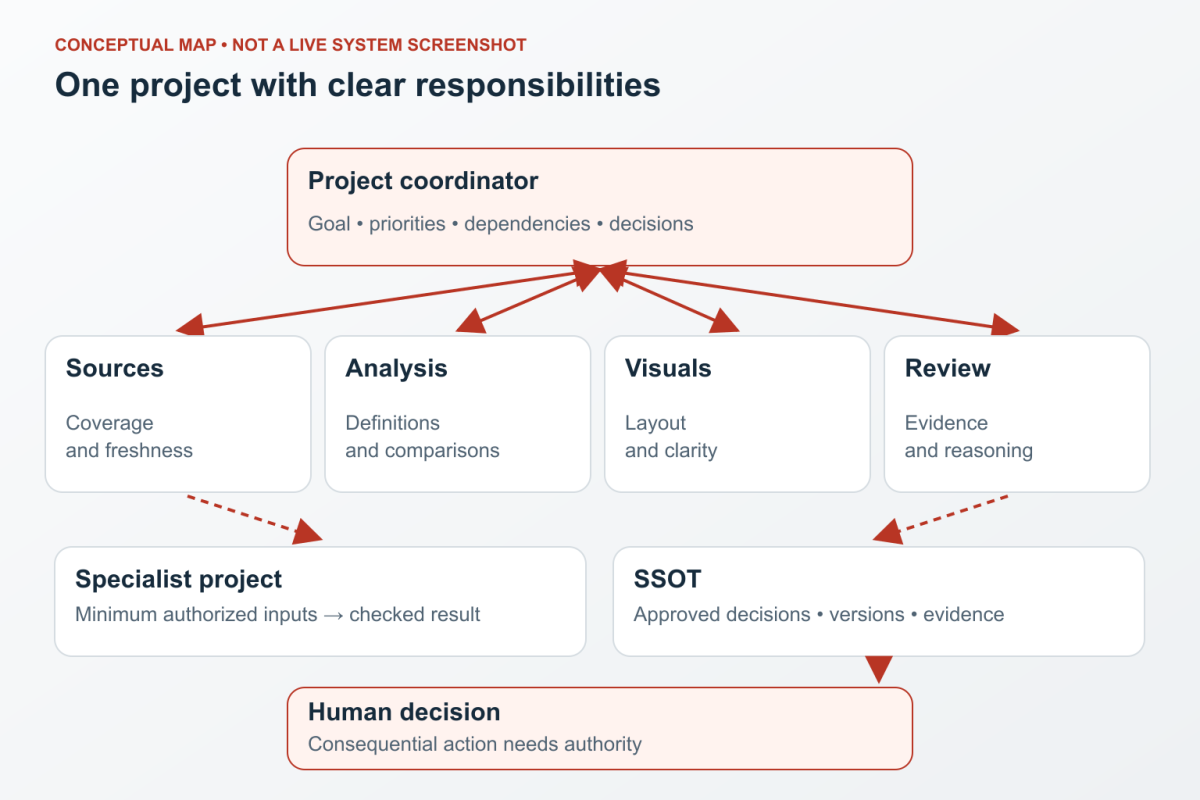
A client asks for an outcome, not a collection of chats. The task may be to understand why sales have slowed, improve a website or build a decision dashboard. Each involves different expertise, sources and risks. Giving the same broad request to several assistants does not create a coordinated project.
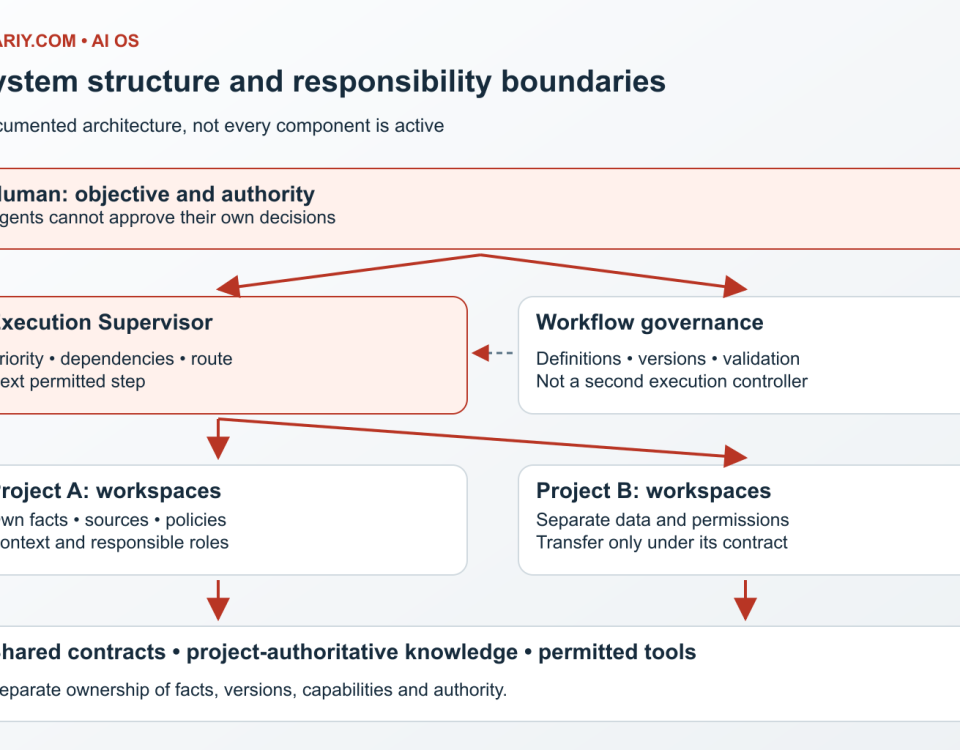
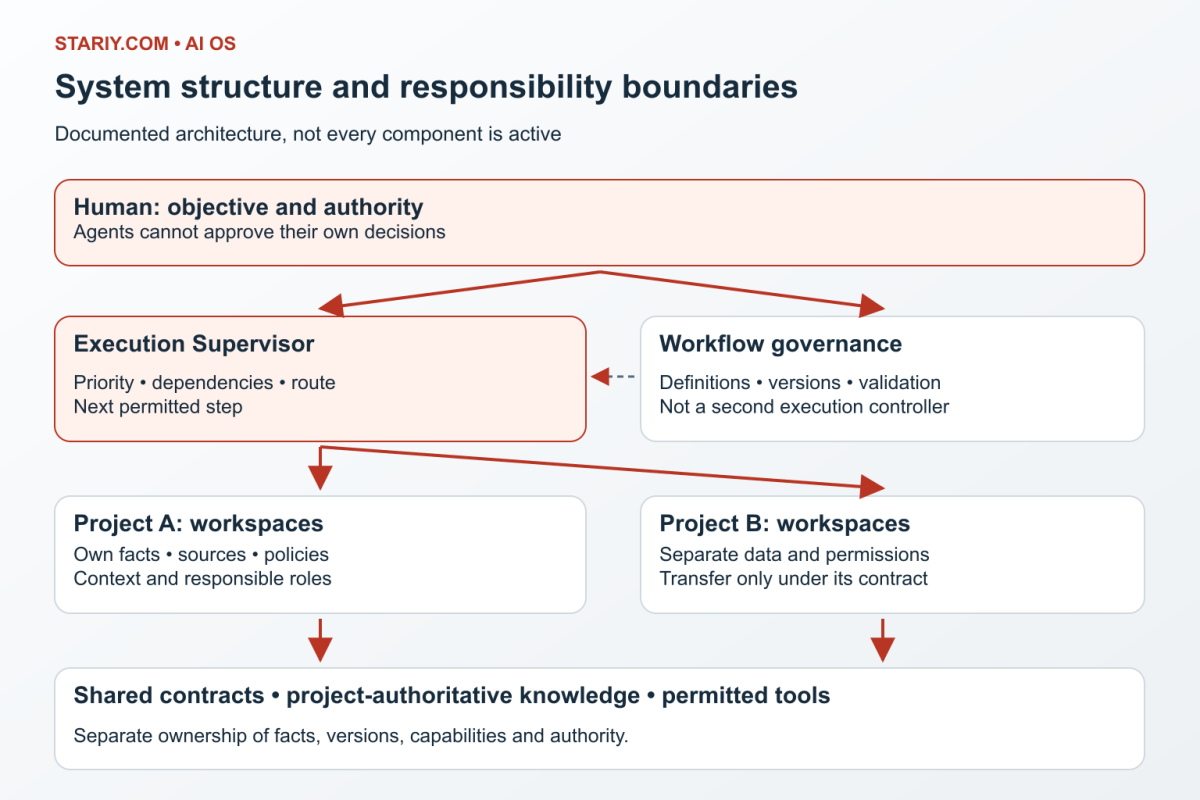
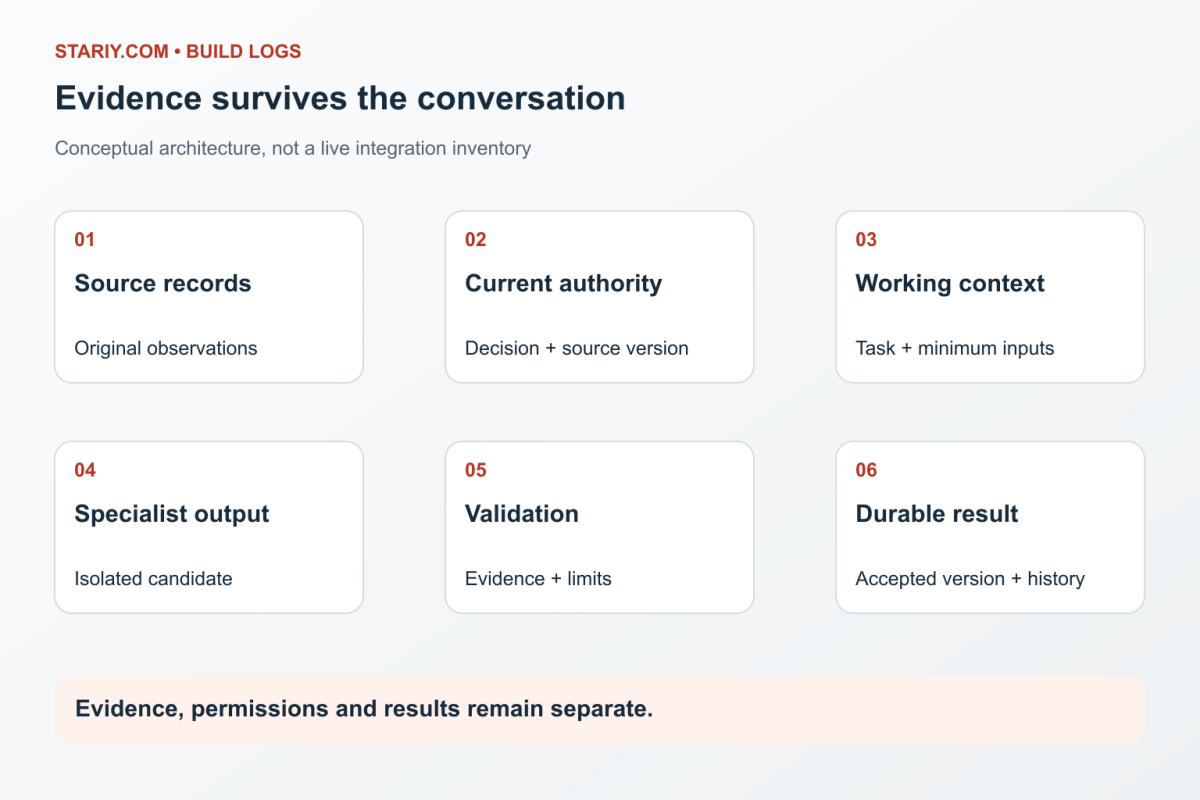
My approach is to organize the work around a project coordinator, specialist workspaces and durable evidence. The coordinator keeps the objective and dependencies visible. Specialists return bounded results. Important decisions and accepted outputs survive outside the conversation.
This is part of my AI OS: an organized working environment, not a separate computer operating system. The useful question is not how many agents I can start. It is whether their work adds up to an inspectable result that answers the original task.
Workspaces agents and workflows
In my current implementation, many workspaces are represented by separate chats. What matters is not the conversation interface itself, but an assigned responsibility, available context, instructions, sources and rules for returning results. Another AI environment can implement that responsibility through an agent or another organized execution environment.
A workspace is where the context and working materials are organized. An agent is an executor assigned a task with particular capabilities and authority. A workflow is the process: its steps, dependencies, checks, stopping conditions and expected result. A chat is the conversational interface; a conversation alone does not establish an autonomous agent.
A specialist chat can be the place where a defined workflow runs, but the two are not equivalent. One workspace can execute several workflows. One workflow can also span several workspaces, agents and tools.
For example, an analytical workspace may compare periods in one task and investigate attribution in another. Preparing a management report is a broader workflow that can involve source preparation, analysis, visualization and review. The number of chats therefore does not tell us the number of workflows.
Start with the decision the client needs
Consider an illustrative request: identify where a marketing team should invest its next unit of time and money. This example contains no client data or actual performance figures.
Before splitting the work, I need the business objective, available evidence, relevant period and decision boundary. Are we optimizing revenue, qualified leads or contribution after costs? Which sources are authoritative? Is the task to recommend a change or execute it?
A project brief turns those questions into a shared contract. It records the desired output, constraints, responsibilities, acceptance checks and unresolved questions. The workspaces inherit the applicable operating rules; they do not invent separate versions of the client’s goal.
A structured setup can be prepared from reusable templates. Fully automatic creation and activation of every new project is a further implementation step, not something I assume has happened whenever a plan exists.
Keep one coordinator and clear specialist responsibilities
The project coordination workspace holds priorities, dependencies, decisions and compact results. It should not become a warehouse for every export, intermediate chart and execution log.
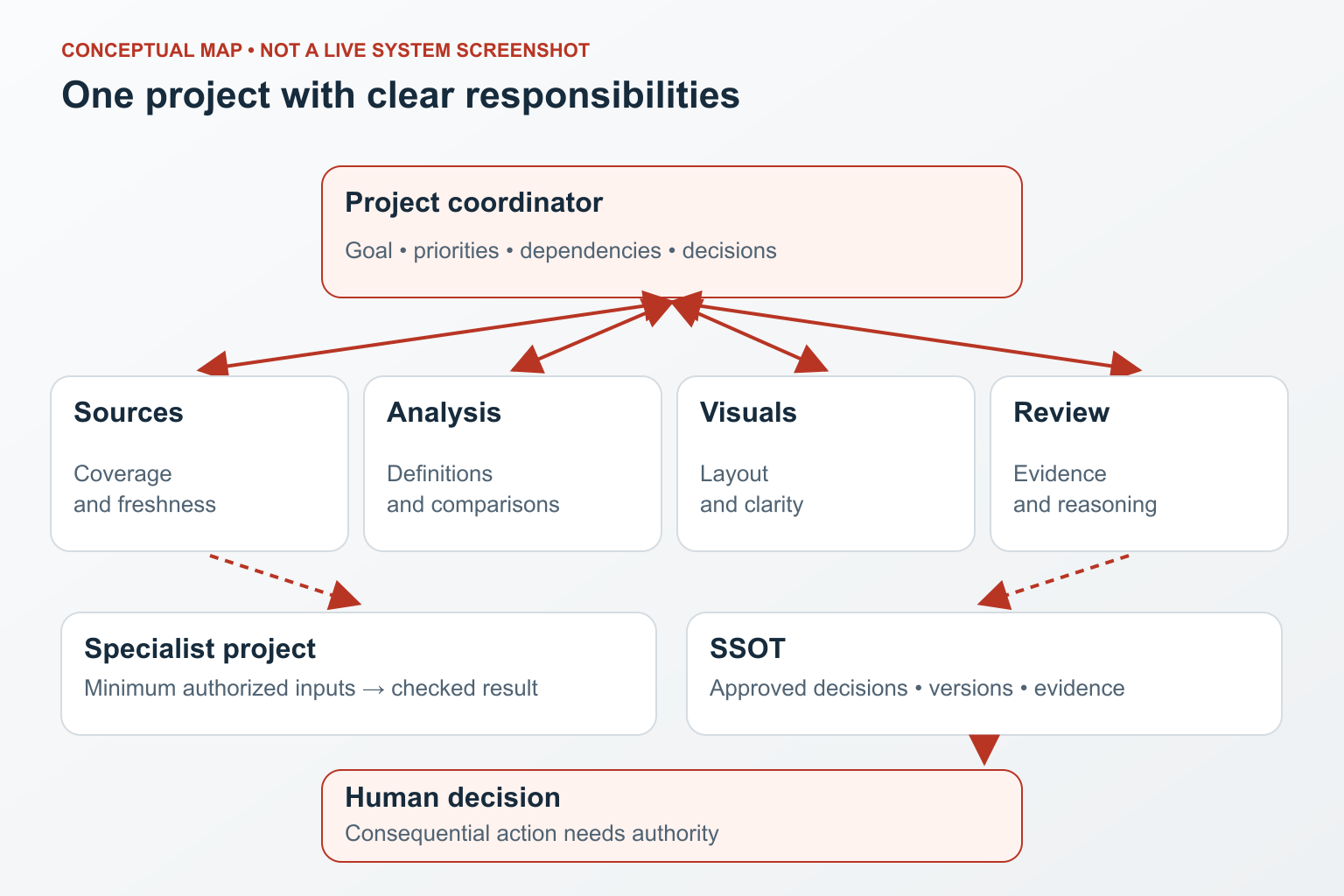
For this example, source preparation checks the available records and their freshness. An analytical workspace defines compatible comparisons and explores the business question. Another workspace prepares clear visuals. A reviewer checks the evidence and the reasoning. The coordinator brings the accepted outputs together.
These are responsibilities, not a mandatory number of workspaces. A small task may need one workspace. A complex project may need several. Splitting work is useful only when it creates a meaningful boundary in evidence, tools, expertise or independent verification.
Parallel work depends on isolated outputs
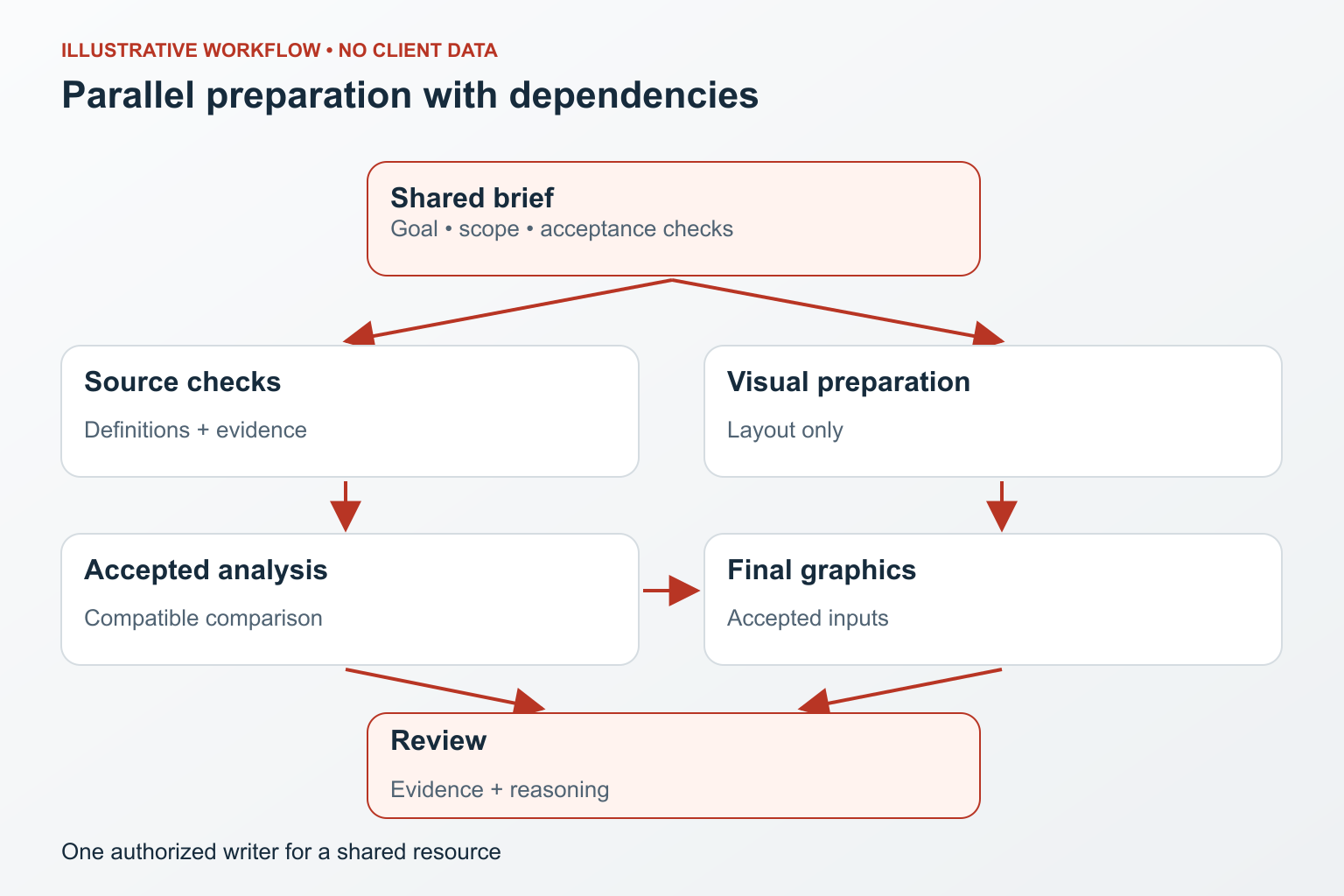
Some activities can proceed together. A visual specialist can prepare a layout while an analyst evaluates source coverage. A reviewer can examine a frozen section while another specialist works on an unrelated section.
Other activities must wait. A final chart cannot be accepted before its metric definition and input data are settled. A recommendation cannot be accepted merely because its formatting is complete.
The workflow therefore records dependencies rather than treating every task as parallel. Specialists prepare separate candidate outputs. One authorized writer applies accepted changes to a shared resource. If the source revision changed during the work, the candidate must be reconciled before it replaces anything.
Parallel preparation is not simultaneous uncontrolled editing of the same document, database or website. That distinction protects both the evidence and the client’s work.
Pass a task with its context and return contract
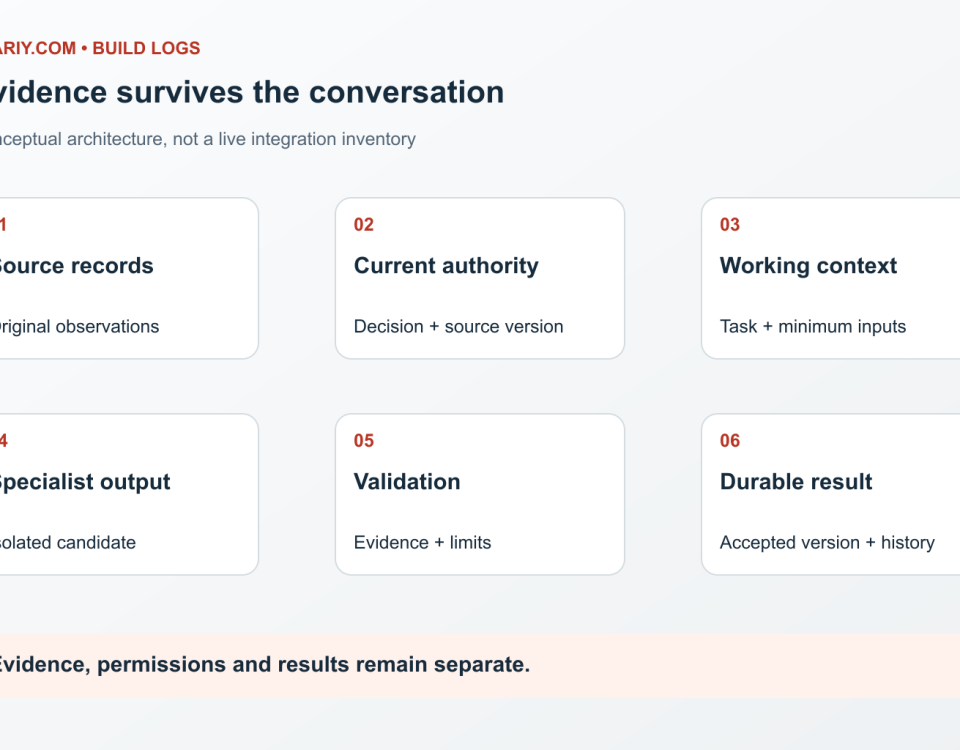
A useful handoff says what to do, what to read, what may change and what must remain untouched. It carries source versions, permitted actions, acceptance checks, open questions and the exact return destination.
For the marketing example, the analyst receives the agreed business question, retained source snapshots and metric definitions. The returned result identifies the comparisons performed, limitations, findings and proposed next action. It does not silently become permission to change advertising budgets.
Automatic delivery between existing authorized workstreams is part of the operating approach where a verified native route is available. Delivery must be confirmed. Sending a task is not evidence that the recipient completed it, and receiving a result is not evidence that it passed review.
Where a route is unavailable, the boundary should remain visible. An unsupported transfer is not replaced with an improvised channel that bypasses access controls.
Use specialist projects without opening the whole client workspace
Sometimes a task needs expertise maintained elsewhere: a website construction workflow, a document template or a particular analytical method. The project can request that capability and receive a checked result.
The transfer should carry only the minimum authorized information. A specialist may need a sanitized example, a metric contract or an approved visual specification. It does not automatically need the client’s complete history, contact details or raw business records.
The original project retains ownership of the business question. The specialist owns its bounded deliverable. The coordinator reconciles the returned output with the current project state instead of treating an external result as automatically authoritative.
Reusable method and private evidence are different things. A good approach can travel; confidential client data cannot travel with it by default.
Improve skills through reviewed experience
Here, a skill is a reusable set of instructions, supporting assets and checks for a defined type of work. A workflow connects such capabilities in a sequence with dependencies and stopping conditions.
A project may reveal a better validation step, a clearer handoff or a recurring failure. I want that lesson retained, but not immediately turned into a universal rule. It needs its source, applicability, review and bounded validation.
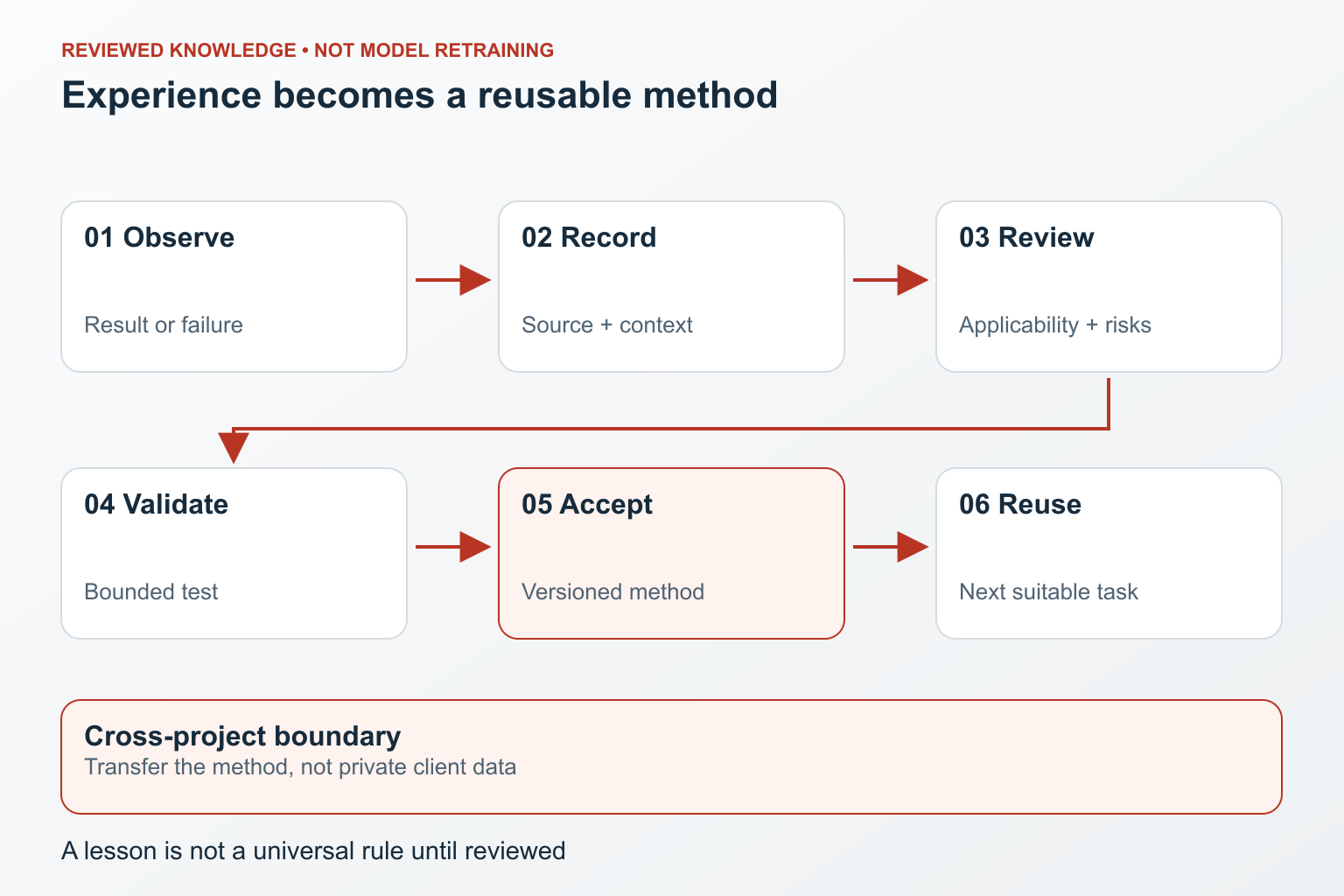
A corrected method can then help the next project avoid the same error. Historical records remain available, so later corrections do not erase how the original conclusion was reached.
This is how the environment develops over time: through durable, reviewed improvements rather than a claim that every agent independently becomes wiser after every conversation.
What is operating and what still needs implementation
The working practice includes persistent knowledge, defined workstreams, bounded handoffs and confirmed internal transfers. It also includes a human decision boundary: publication, consequential business changes and sensitive disclosures require their applicable authority.
The project structure and concurrency rules are documented. That is different from certifying every connector, provider, project template or automated deployment route. An isolated test is evidence for its tested scope, not proof of universal production readiness.
For a new client task, I still need to establish the sources, responsibilities, permissions and actual available routes. Full automatic onboarding is a direction for development, not a promise that an arbitrary request can safely create and activate everything without those checks.
The result is accountable work rather than more conversation
The coordinator should be able to answer: what was requested, who owns the next step, which evidence supports the result, what changed and which decision still belongs to a human?
That is the practical value of this structure. It makes parallel work understandable, gives specialists enough context without unrestricted access and turns useful experience into reusable methods.
More chats are not the objective. A coherent, verifiable result is.